
BAL-Rated Composite Decking: What Australians Need to Check
A composite deck can look like the right choice and still fail to meet a site’s bushfire requirements. That’s why “BAL rated composite decking” shouldn’t be treated as a blanket claim about a material. The evidence needs to relate to the specific product and tested configuration, while the required BAL is determined for the individual site.
If you’re comparing products, it’s understandable to want a simple yes or no. But a general description, or a fire test that measures a different property, may not establish suitability for your project. Before you specify or buy, check what BAL means, what the relevant documents show and what information your designer, building surveyor or other qualified project professional needs to assess compliance.
This guide explains the limits of BAL terminology, the role of AS 3959:2018 and product-specific testing such as AS 1530.8.1, plus the details to confirm in a report, including its scope and conditions. You’ll also find practical questions to ask a supplier, so you can establish what current evidence is available and seek project-specific advice before committing.
Table of Contents
BAL-rated composite decking in Australia: what the rating tells you
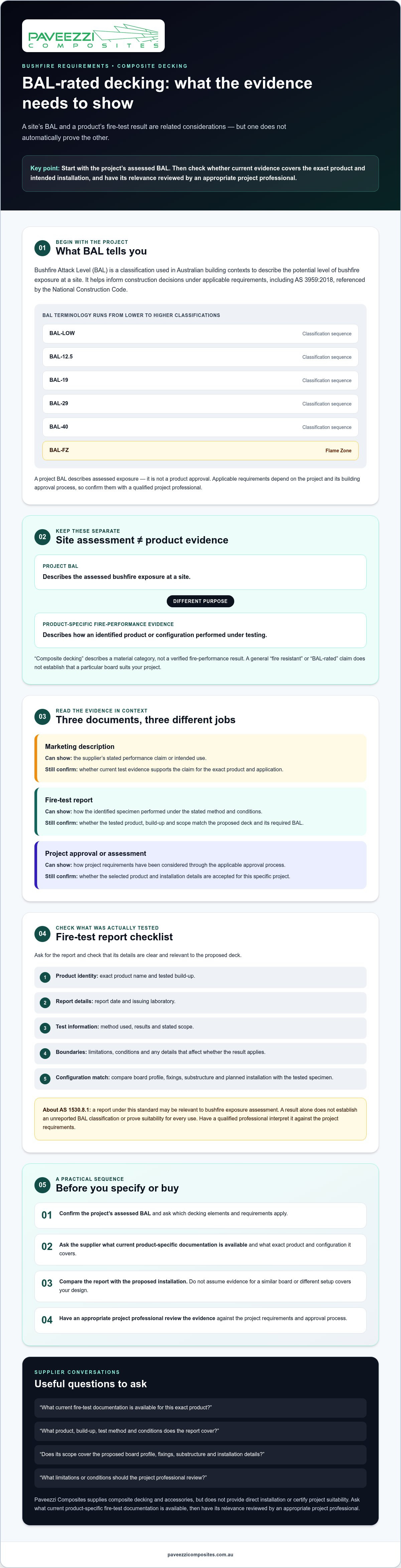
Bushfire Attack Level, or BAL, is a classification used in Australian building contexts to describe the potential level of bushfire exposure at a site. It helps inform construction decisions under applicable requirements, including those in AS 3959:2018, referenced by the National Construction Code. Bushfires are a widespread and regular occurrence in Australia, but a BAL classification describes assessed exposure, not the performance of every building material.
A project BAL describes the assessed bushfire exposure at a site; product-specific fire-performance evidence describes how an identified product or configuration performed under testing. These are related considerations, but one doesn’t automatically prove the other.
What does a BAL classification mean for a building project?
A project assessment considers the site and informs the bushfire-related construction requirements that may apply. BAL terminology runs from BAL-LOW through BAL-12.5, BAL-19, BAL-29 and BAL-40 to BAL-FZ, or Flame Zone. The classification isn’t a product approval, and the applicable requirements depend on the project and its building approval process. Confirm the current requirements with a qualified project professional.
Why composite decking needs product-specific evidence
The words “composite decking” describe a material category, not a verified fire-performance result. A general statement that a board is fire resistant doesn’t establish that it meets the requirements for a particular BAL. For BAL rated composite decking, look for current test documentation that identifies the product and explains what was tested, the method used and the scope of any claimed result.
Check how closely the evidence matches the proposed build. Board composition or profile, fixings, substructure and installation details may affect whether test results apply to the system being specified. Don’t assume a report for a similar board or a different setup covers your design. Ask the supplier what current report is available and what it covers, then have the project team assess its relevance.
Paveezzi Composites supplies composite decking and accessories, but doesn’t provide direct installation or certify project suitability. You can review its composite decking options, then ask what current product-specific fire-test documentation is available before relying on a BAL claim. The evidence and project review matter as much as the label.
Does “BAL-rated composite decking” mean every board is suitable?
No. A broad “BAL-rated” label isn’t enough to establish that a particular board suits your project. The claim needs product-specific evidence, and that evidence must cover the intended use. A marketing description, a test report and a building approval each serve a different purpose. Treating them as interchangeable can leave important questions unanswered.
Use this comparison to assess the information you’ve been given:
What should a decking fire-test report identify?
Ask for the exact product name, tested build-up, report date and issuing laboratory. Check the test method, results and stated scope, including any limitations or conditions. A report under AS 1530.8.1 may be relevant to bushfire exposure assessment, but a result alone doesn’t establish an unreported BAL classification or prove suitability for every use. Have a qualified professional interpret it against the project requirements.
Small differences can matter. A report for one board profile, fixing method or supporting structure may not cover another configuration. Compare the specimen with the proposed boards, fixings and substructure, and check whether the planned installation details fall within the report’s scope.
How do standards and building requirements fit together?
AS 3959:2018 addresses construction in bushfire-prone areas, while AS 1530.8.1 is a relevant test method for assessing building elements exposed to bushfire conditions. Check the current editions and their applicability to your project with the relevant building professional. A standard cited in a brochure or report isn’t, by itself, proof that a specific product complies or has project approval.
If you’re assessing a supplier’s range, visit Paveezzi Composites’ website and ask what current, product-specific documentation is available for the decking you’re considering. Paveezzi is a material supplier, not an installer or certifier. Ask your building surveyor, designer or other relevant professional to assess the evidence for your project.
How to check composite decking for your project’s BAL requirements
Begin with the project, not a shortlist of boards. Product evidence is useful only if it addresses the site’s assessed BAL and the deck element being specified. Use this checklist with your designer, building surveyor or other relevant project professional before placing an order.
Confirm the project classification. Ask the project professional to confirm the applicable BAL and which part of the proposed deck the assessment covers.
Identify the exact product. Record the decking product name and any relevant board profile or system components. Don’t rely on evidence for a similar product.
Ask for current documentation. Ask the supplier whether a fire-test report and supporting information are available for that exact product. Check the test method, report date, issuing laboratory, stated result and limitations.
Match the evidence to the design. Compare the report’s tested build-up and intended application with the proposed boards, fixings, supporting structure and installation details.
Confirm project acceptance before ordering. Have the relevant professional interpret the evidence against the project requirements and applicable approval process. If information is missing, ask what is unavailable rather than treating the gap as evidence of suitability.
Questions to ask a supplier before specifying boards
Ask plainly: “Does this documentation cover this exact decking product and the configuration we’re proposing?” Request the report’s scope and any conditions on its use. Clarify whether the evidence relates to a particular BAL or records a test result without assigning a BAL classification. A supplier can explain what documentation is available; the project professional determines whether it applies to the design.
For BAL rated composite decking, the distinction matters. Naming a test method or standard, including AS 1530.8.1, doesn’t by itself establish that a product meets a project’s requirements. Confirm current standards and their applicability with your project team.
Checks to complete with your project professional
Ask whether the documentation covers the complete deck design, including supporting components, and whether the proposed installation details align with the report and project requirements. If you’re comparing products, review Paveezzi Composites’ composite decking range, then ask what current product-specific evidence is available for the option you’re considering. Paveezzi supplies materials and doesn’t provide direct installation, so suitability needs appropriate professional review.
Before ordering, confirm the project classification, the scope of the product evidence and project approval. To ask Paveezzi about available product documentation, contact the supplier through its website.
Choosing a composite decking supplier for a BAL-sensitive project
A useful supplier should be able to identify the exact decking product you’re considering and explain what current technical and fire-test documentation is available. Look for clear answers about the evidence’s scope, including which product configuration was assessed, what application it covers and whether any limitations apply. Broad claims about composite decking as a category aren’t a substitute for these details.
Paveezzi Composites is a family-run Australian supplier of composite decking, cladding and related materials, with national supply. It doesn’t provide direct installation or project certification. Don’t assume its Ressisto or Riviera products are BAL-rated or suitable for a particular project unless current evidence supports that claim for the exact product and proposed use.
What transparent product information should include
Ask for documentation that names the product precisely, rather than referring only to a brand or broad product category. Request current technical information and any relevant fire-test report, then check the report’s date, test method, specimen details, result and stated scope. A supplier should be able to clarify what the evidence does and doesn’t cover. If a document or answer is unavailable, treat that as an open question to resolve, not confirmation of suitability.
With BAL rated composite decking, documentation is only one part of the decision. Your building surveyor, designer or other relevant professional needs to consider whether the evidence applies to the project’s assessed BAL, deck design and proposed installation details.
Next steps before ordering composite decking
Before specifying or purchasing, have the project BAL and required construction details confirmed by the appropriate professional. Then ask for current evidence for the exact product under consideration and check that its scope matches the intended use. Keep the product name, proposed configuration and relevant project requirements together so your supplier and project team can respond to the same information.
Once you have those details, you can ask Paveezzi about relevant product information without treating the enquiry as a substitute for professional approval. Discuss your composite decking enquiry.
Make your next decking decision with confidence
Choosing BAL rated composite decking starts with the project’s assessed requirements, not a broad product label. Confirm the applicable BAL with your project professional, ask for current fire-test evidence for the exact product and configuration, and check that its scope matches the proposed design before specifying or ordering.
Clear documentation helps you ask better questions, but project-specific suitability needs review by the appropriate building professional. A supplier can provide product information; it isn’t a substitute for assessment or approval.
Paveezzi Composites is an Australian family-run supplier established in 2010, supplying composite decking and accessories nationally. If you’re considering its products, ask what relevant, current documentation is available and have your project team assess whether it applies to your plans. For product information, discuss your composite decking enquiry.
With the right evidence and professional guidance in hand, you can move forward with greater clarity and confidence.
Frequently Asked Questions
What does BAL-rated composite decking mean?
It means evidence is being presented that an identified decking product or configuration has been assessed for bushfire exposure at a stated level. The phrase alone isn’t proof. Check the current test report, including the exact product, tested configuration, method, result and scope. A site’s BAL is determined through project assessment; it doesn’t automatically certify a decking board. Have a qualified project professional check whether the evidence applies to your design.
Is all composite decking suitable for BAL-29 or higher?
No. Composite decking isn’t automatically suitable for BAL-29 or any higher level because it’s composite. Suitability depends on current product-specific evidence and whether its scope matches the proposed use and project requirements. Ask for the report for the exact board and configuration, then have a relevant professional review it. BAL-40 and BAL-FZ have distinct requirements, so don’t assume evidence for a lower BAL covers them.
Can I use composite decking in a bushfire-prone area?
Possibly, but the answer depends on the site assessment, applicable building requirements and evidence for the specific product and proposed deck design. First confirm the project’s BAL with a qualified professional. Then check whether the decking documentation covers the intended use, supporting components and installation details. A general description of composite material or a supplier’s broad claim isn’t enough to confirm suitability for your project.
What documents should I ask for when buying BAL-rated decking?
Ask for current, product-specific technical information and the relevant fire-test report, if available. Check that it names the exact product and identifies the tested configuration, test method, result, report date, issuing laboratory and scope, including any limitations. Don’t infer a BAL classification or permitted use that the report doesn’t state. Provide the documents to your designer, building surveyor or other relevant professional to assess their applicability before ordering.
Does a BAL rating apply to the decking board or the whole deck?
A project BAL describes assessed bushfire exposure at the site; it isn’t a universal rating for a board or complete deck. Test evidence may cover a particular product specimen or assembly, so check exactly what was assessed. Boards, fixings, supporting structure and installation details may affect whether the evidence applies to your proposed system. Ask a qualified project professional to review the design and relevant documents together.
Which Australian standards apply to BAL-rated composite decking?
AS 3959:2018 addresses construction in bushfire-prone areas, while AS 1530.8.1 is a relevant fire-test method for assessing building elements exposed to bushfire conditions. The National Construction Code references bushfire construction provisions, but citing a standard doesn’t prove that a particular product complies. Confirm current editions and project applicability with your building surveyor, designer or other relevant professional, and check that product evidence matches the intended application.
Comments