
Commercial Building Facade Cladding: A 2026 Selection Guide
The best-looking facade option may be the wrong place to start. Choosing commercial building facade cladding means weighing appearance against durability, project requirements and documented evidence, including fire-performance information. A finish can suit the design intent, but it still needs to be assessed against the building and its compliance pathway.
If material claims are difficult to compare or you’re unsure which questions to raise, start by separating what the project needs from what each product can demonstrate. The right choice depends on more than a product description. This guide sets out a practical way to build a shortlist around design priorities, project conditions and documentation, then identify what to confirm with your project team.
We’ll compare common cladding considerations, outline the technical and compliance questions to ask, and explain what to check in supplier information. We’ll also clarify an important distinction: product supply doesn’t automatically include system design or installation. Paveezzi Composites is a family-run Australian supplier with composite cladding options including Ressisto and Lightissimo products. Knowing what a supplier provides, and what your project team must arrange separately, helps keep responsibilities clear from selection through to procurement.
Table of Contents
How to assess commercial building facade cladding against project needs
Compare commercial building facade cladding against the building brief, not appearance alone. A finish may suit the design intent, but suitability also depends on building use, form, exposure, maintenance expectations and documented project requirements. Write down those criteria first, then assess which products merit further review.
Cladding can contribute to a building’s appearance and help protect its exterior. The overview of cladding materials describes the range of materials and purposes. For a project decision, rely on current product documentation and advice from the design team rather than general descriptions of a material category.
Which project requirements should shape the cladding shortlist?
Record the conditions each option needs to meet before comparing finishes. A simple checklist makes the shortlist easier to explain and helps the team identify what evidence is still needed.
Project use and form: Note the building’s intended use, height, substrate, facade geometry and design constraints around openings or panel layouts.
Exposure and access: Ask the project team to assess relevant site exposure, access for inspection or maintenance, and expected cleaning requirements.
Design intent: Document the desired appearance, including colour, texture, profile and how the facade meets adjacent materials.
Performance evidence: Ask which criteria must be documented for this project and which professionals are responsible for reviewing them.
Keep the shortlist practical. Retain options only when product information can be checked against the brief, and mark any missing details for follow-up. Don’t assume a particular finish or broad material category proves suitability. Confirm product specifications, dimensions, finishes and installation information against current documentation. Once the criteria are defined, Paveezzi Composites’ composite cladding range can be considered as a product-supply option.
Why does facade cladding need to be assessed as a system?
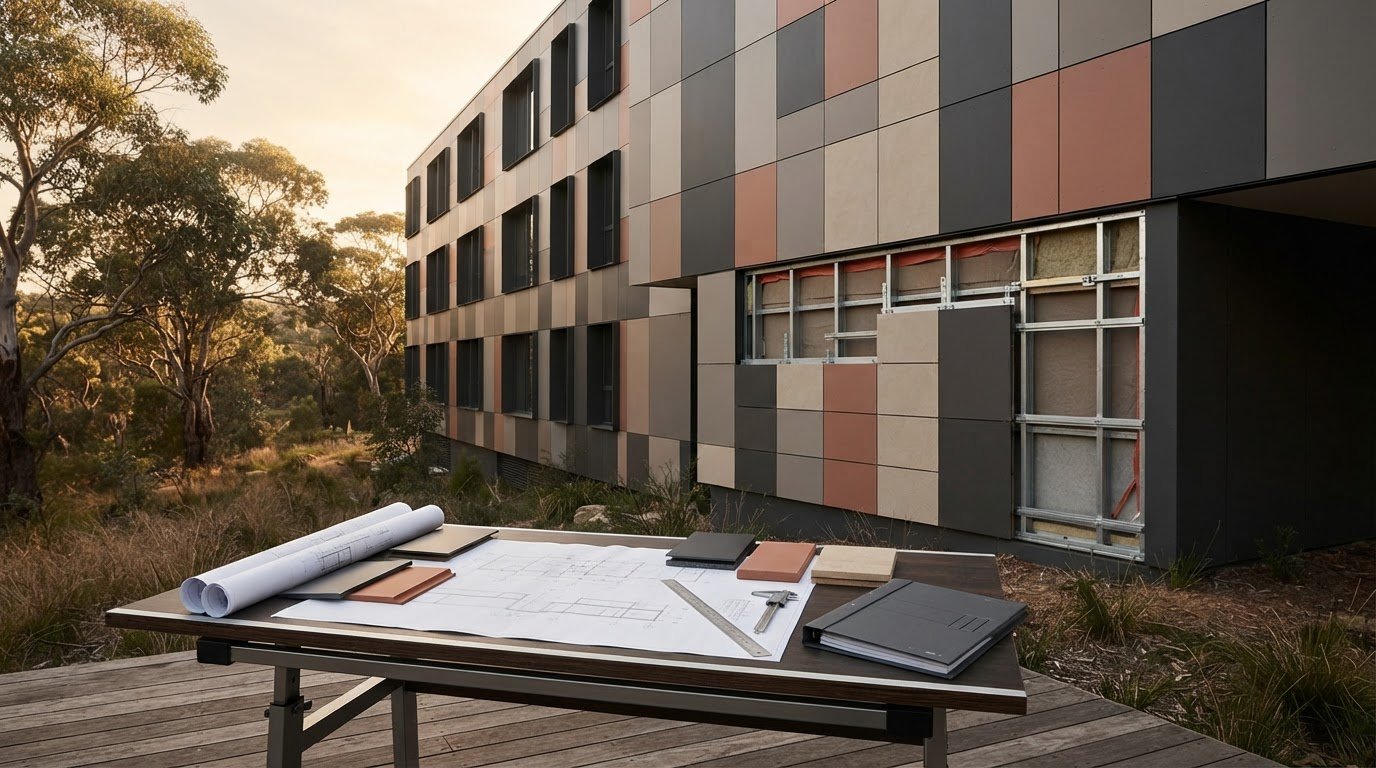
The visible cladding is only one part of the facade. The support structure, fixings and interfaces also need to work together. Check how proposed details are coordinated at openings, corners and junctions, and ask the design team to review how they connect with the rest of the building envelope. Don’t infer how the complete assembly will perform from a panel sample alone.
A cladding product is the visible material; a complete facade system also includes the supporting structure, fixings and coordinated interface details.
Confirm who is responsible for system design, documentation and installation before procurement. A supplier may provide products without providing direct installation, so arrange that scope separately and have the relevant professionals review the selected details.
How to compare facade cladding materials, finishes and evidence
Use the same comparison framework for every option. This keeps design preferences visible without letting a polished sample stand in for technical evidence. Compare products against the same project criteria, and label unanswered questions clearly instead of filling gaps with assumptions.
What should a commercial facade cladding comparison table include?
Record each option’s material, profile, finish, available documentation and unresolved project questions. Include maintenance expectations and project fit so the team can see what needs checking before the shortlist is narrowed.
These are comparison prompts, not performance rankings. Specification, substrate, support structure, fixings and installation details can all affect how a facade system performs. If a document or detail is missing, label it “to confirm” and assign someone to follow it up. Paveezzi Composites’ commercial cladding range can be reviewed as a category reference, with product-specific details checked against current documentation.
How should you verify facade performance and compliance claims?
Ask suppliers for current technical data and test reports relevant to the proposed product and application. Check that each document matches the specified product, configuration and intended use. A general brochure may not answer a project-specific question. The design team should confirm applicable National Construction Code provisions, standards and approval pathways with the relevant qualified professionals.
Compliance depends on current evidence for the specified product and assembly, assessed against the project context and applicable requirements. A product label alone is not enough to establish suitability. For broader professional context, CIBSE’s Society of Facade Engineering supports knowledge and practice in facade engineering.
As a practical next step, compare your shortlist with Paveezzi Composites’ company information, then confirm product documentation and supply scope directly before specifying.
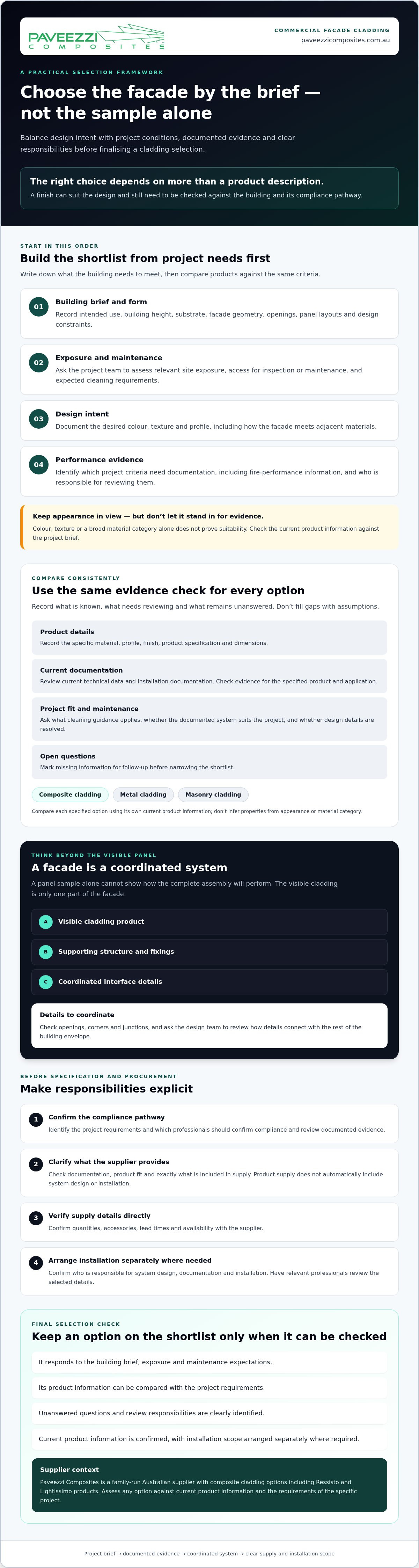
What should project teams check before specifying commercial facade cladding?
A clear pre-specification process helps the team resolve compliance questions, documentation gaps and scope boundaries before the facade is finalised. For commercial building facade cladding, assign each check to the right professional and keep a record of what’s confirmed, outstanding or subject to approval.
Set the project brief. Record the building classification, intended use, design requirements and relevant site conditions.
Confirm the compliance pathway. Ask the building surveyor and relevant compliance professionals which current National Construction Code (NCC) requirements apply to this project and building classification. Have qualified professionals assess fire performance and identify the evidence needed for the proposed application.
Allocate responsibilities. Clarify the roles of the architect, facade consultant, building surveyor, supplier and installer. Confirm who will prepare and review system details, check product documents and coordinate approvals.
Review product and system information. Match the specified product name, profile and finish to current supplier records. Request relevant technical data, installation guidance, care information and test documentation.
Resolve details before approval. Check interfaces at openings, corners and junctions, maintenance access and coordination with the installer. Record remaining questions and approvals in the project checklist.
Which Australian compliance questions should be resolved first?
Don’t assume one standard or test applies to every building or cladding assembly. Ask the project’s qualified professionals whether AS 5113 or another standard is relevant to the proposed product, system and approval pathway, and what evidence is required. The Whole Building Design Guide on building envelopes offers broader context for considering the exterior as part of the building’s overall design.
What documentation should be collected before approval?
Keep documents tied to the exact product and proposed application. If a report, installation detail or approval is missing, mark it as outstanding rather than treating a general product description as proof. For further background on system considerations, see this commercial exterior cladding guide.
Before confirming a supplier, check its current records against the specification and clarify what supply includes. Paveezzi Composites supplies cladding products but doesn’t provide direct installation services, so project teams need to coordinate installation separately. Review Paveezzi Composites’ product information as one step in that supplier check.
How to shortlist commercial facade cladding suppliers and plan next steps
Once the project criteria are clear, assess suppliers against the same brief. For commercial building facade cladding, compare the relevance of product documentation, how clearly questions are answered, whether the range fits the design intent, and what the supply scope includes. A consistent checklist makes it easier to spot missing information and compare responses fairly.
What should you ask a commercial cladding supplier?
Use the same questions for each supplier so you can compare responses on a like-for-like basis:
Can you provide current technical information and confirm the exact product, profile and finish being considered?
Which product details and documents should the project team review for this proposed application?
What is included in product supply, and what needs to be arranged separately?
Can you confirm current availability, estimated lead times, quantities and any required accessories for the project?
Clear answers help reveal whether a supplier’s range and communication suit the project. They also help prevent assumptions about services. Product supply doesn’t automatically include design, approvals, installation, inspections or ongoing maintenance. Confirm who is responsible for each with the relevant project professionals and installer, then record the agreed scope in writing.
How can Paveezzi products enter a considered shortlist?
Paveezzi Composites is a family-run Australian supplier. Its confirmed cladding options include Cladding Ressisto 144 Fineline and Cladding Ressisto Lightissimo202. A project team can assess these products against its brief, but neither should be assumed to suit every building or facade assembly. Check current product information, dimensions, finishes and installation documentation before progressing.
For broader design context, Paveezzi’s architectural composite cladding guide may be a useful related resource. Keep the final review grounded in documented project requirements and the supplier’s current records.
Before procurement, confirm quantities, accessories, availability and lead times directly with the supplier. Make sure the specification identifies the agreed product and finish, while the project team separately coordinates design review, approvals, installation, inspections and maintenance responsibilities. Resolving these details early can make the next steps clearer.
Once your project requirements are defined, explore Paveezzi’s cladding options as part of your supplier shortlist.
Make your shortlist with confidence
A sound cladding decision starts with the project brief, not a finish sample. Compare each option against the building’s design and documented requirements, then check that product information relates to the proposed application. Confirm how the cladding, supporting details and interfaces are addressed as part of the facade system.
Before you specify commercial building facade cladding, resolve who is responsible for compliance review, design coordination and installation. Check the supplier’s exact product details, documentation, quantities, accessories and current availability. Keep unanswered questions visible in the project record so they can be resolved before procurement.
Paveezzi Composites is a family-run Australian supplier with confirmed options including Ressisto 144 Fineline and Ressisto Lightissimo202. Project teams can assess these against their own criteria and current product information. Product supply doesn’t include direct installation, so installation arrangements need to be confirmed separately.
When your project requirements are defined, explore Paveezzi’s cladding options as part of your shortlist. With clear criteria and the right questions in hand, you can move forward with greater confidence.
Frequently Asked Questions
What is commercial building facade cladding?
Commercial building facade cladding is an external layer fitted to a building’s exterior to shape its appearance and contribute to protection from weather. It may use materials such as metal, masonry or composite. The visible product is only one part of the assembly, which also includes supports, fixings and junction details. Project documents should define how those components suit the specific building.
How do you choose cladding for a commercial building facade?
Choose cladding by comparing each option with the project brief, not appearance alone. Consider the building’s use, height, substrate, facade geometry, exposure, design intent and maintenance access. Then compare current product documents against the criteria identified by your project team. Ask the architect and relevant technical professionals to assess project fit, resolve system details and identify any evidence needed before specifying the product.
What should be checked before specifying facade cladding in Australia?
Before specifying, confirm which current National Construction Code (NCC) provisions and approval pathway apply to the project and building classification. Ask the project’s qualified professionals to review the proposed assembly, relevant test evidence and interface details. Check that product names, profiles and finishes match supplier records, and request current technical data, installation guidance and care information. Record unresolved approvals and installation responsibilities for follow-up.
Does commercial facade cladding need to meet fire performance requirements?
Fire performance requirements depend on the project and the proposed building and facade assembly, so don’t assume one rule or rating applies to every product. Ask the building surveyor and relevant compliance professionals to identify applicable NCC provisions and the evidence needed for the specific application. Check that any test documentation relates to the product and configuration being considered, then have the project team confirm its relevance.
Can composite cladding be used on a commercial building facade?
Composite cladding may be considered for a commercial facade if the specific product and proposed assembly can be shown to meet the project’s design, documentation and compliance requirements. Assess current technical information, installation guidance and any relevant test evidence with the project team. Paveezzi Composites supplies composite cladding products, including Ressisto options, but suitability should be confirmed for each project rather than assumed from the material category.
Does Paveezzi provide facade cladding installation?
No. Paveezzi Composites supplies cladding products but doesn’t provide direct installation services. Project teams should arrange installation separately and confirm who is responsible for system design, approvals, installation coordination and inspections. Before procurement, check the exact product details, current documentation, quantities, accessories and availability with the supplier. This helps keep product supply and installation responsibilities clear as the project moves towards specification.
Comments