
Composite Wood Look Cladding Australia: The Ultimate 2026 Design Guide
The dream of a silver-grey timber facade often turns into a maintenance nightmare of peeling oils and warped boards within just a few seasons of the harsh Australian sun. Choosing the right composite wood look cladding Australia offers isn't just about finding a substitute for timber; it's about selecting a high-performance architectural system that survives our unique climate. You want the organic warmth of a natural grain without the relentless cycle of sanding and staining that traditional wood demands.
We understand the hesitation that comes with choosing modern materials, especially the fear of a "plastic" finish or the confusion surrounding the latest NCC 2026 compliance and BAL ratings. This guide is designed to bridge that gap. You'll discover how to achieve a sophisticated, maintenance-free exterior using premium systems like the Ressisto 144 Fineline. We'll walk through the technical essentials of fire safety and moisture management to ensure your project delivers lasting value and timeless street appeal. From understanding bushfire provisions to selecting the right textures, we provide the clarity you need to build with confidence.
Table of Contents
The Evolution of Composite Wood Look Cladding in Australia
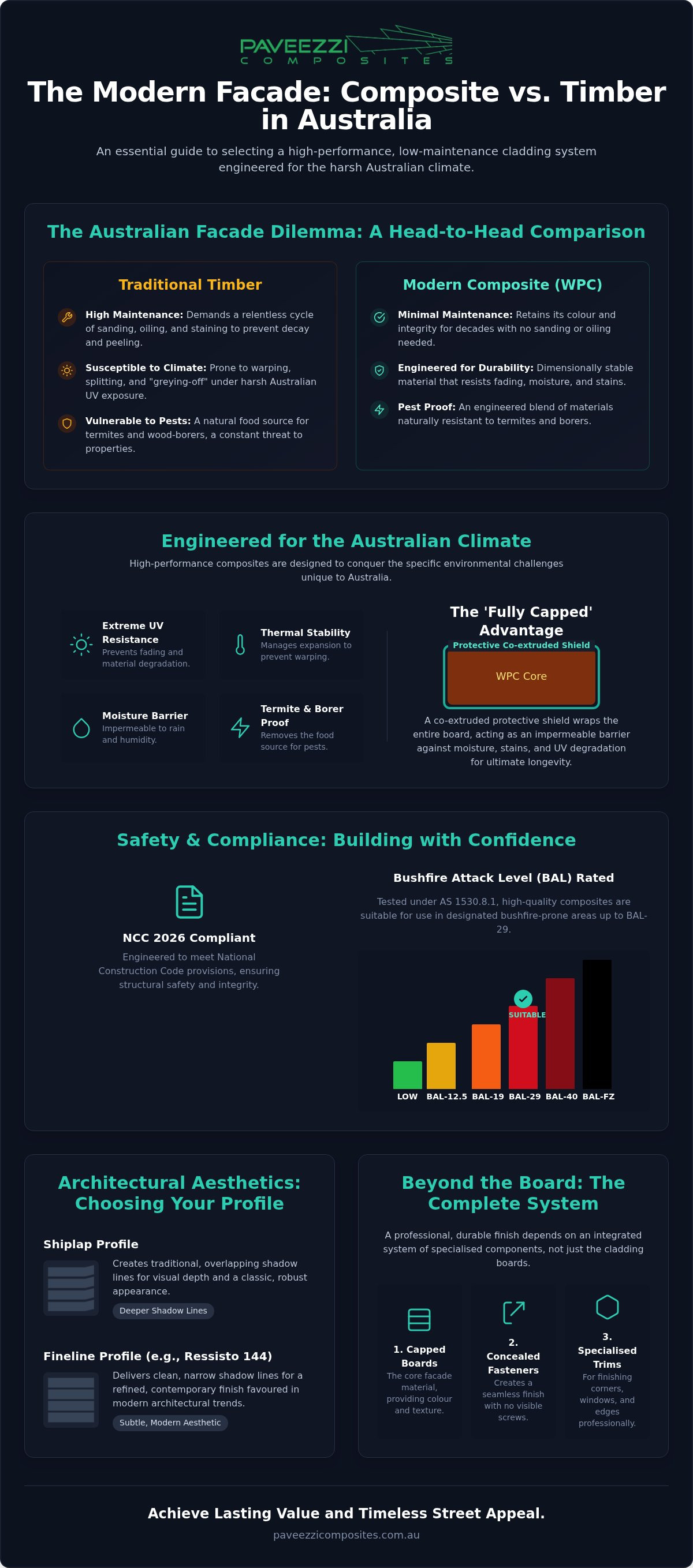
For decades, the Australian architectural aesthetic has been deeply tied to the organic beauty of native hardwoods. However, the reality of maintaining these facades in our unforgiving environment has led to a significant shift in the construction industry. Wood-plastic composites (WPC) represent a sophisticated leap in material science, combining recycled wood fibres with advanced polymers to create a durable, stable building envelope. This evolution has transformed composite wood look cladding Australia wide from a mere alternative into a primary choice for high-end residential and commercial projects. WPC is a meticulously engineered material designed to mimic the cellular structure of timber while providing the structural integrity required for modern Australian building facades.
We've moved beyond the days of "rustic" faux-timber that often looked synthetic or lacked depth. Modern architectural trends now favour clean lines and defined textures, such as the narrow-profile aesthetic found in the Ressisto 144 Fineline series. This shift toward an architectural focus means cladding is no longer just a protective layer; it's a deliberate design statement that defines the character of a home. It's about achieving a refined, contemporary finish that remains stable over time.
Why Timber Look Composites are Trending
Homeowners crave the warmth of natural timber but they don't want the "grey-off" effect that occurs within months of installation. Premium composite wood look cladding Australia systems maintain their colour profile for decades without the need for sanding, oiling, or staining. This consistency adds long-term kerb appeal and protects resale value. By using recycled materials, these systems also reduce the pressure on old-growth forests, making them a responsible choice for the environmentally conscious builder. It's a rare win-win where aesthetics, performance, and sustainability align.
The Australian Climate Challenge
Our climate is notoriously unforgiving. Standard international composites often fail here because they aren't engineered for our extreme UV index or rapid temperature fluctuations. High-performance cladding requires careful thermal expansion management to prevent warping or buckling. Additionally, these engineered boards offer a critical advantage over natural timber: they are naturally resistant to termites and wood-borers. These pests remain a constant threat to Australian properties, and removing their food source from the facade provides essential peace of mind for any homeowner.
Engineering for Durability: Technical Benefits and Compliance
Choosing between exterior materials often feels like a trade-off between beauty and longevity. Natural timber offers undeniable warmth but demands constant oiling to prevent rot. Aluminium wood-look options are low maintenance; however, they often feel clinical and can struggle with thermal noise during expansion. Premium composite wood look cladding Australia provides the ideal resolution. It combines the aesthetic soul of timber with the high-performance engineering required to withstand our harsh seasonal cycles. At Paveezzi, we draw on years of industry leadership to ensure our systems provide this balance. You can learn more about our commitment to quality on our Paveezzi About Us page.
The secret to this performance lies in "fully capped" technology. This process involves a co-extruded protective shield that wraps around the entire core of the board. It acts as an impermeable barrier against moisture, stains, and UV degradation. In the context of the Australian wet and dry seasons, this stability is vital. While traditional timber expands and contracts significantly, leading to split boards and failed fasteners, capped composites remain dimensionally stable. This ensures your facade looks as precise in ten years as it did on day one.
Understanding BAL Ratings and Fire Safety
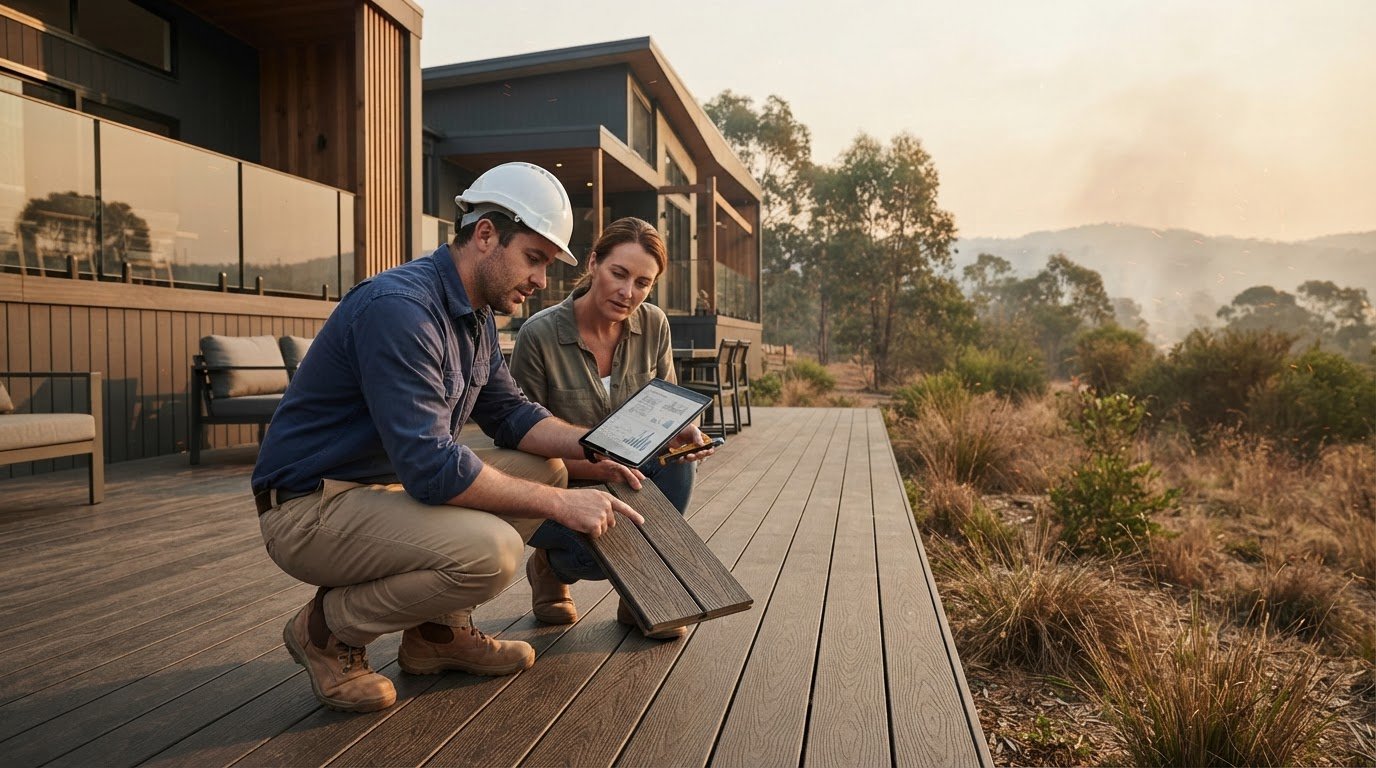
Building in bushfire-prone areas requires strict adherence to Australian building regulations. For many Australian homes, cladding must meet specific Bushfire Attack Level (BAL) requirements. Most high-quality composite ranges are tested under AS 1530.8.1 and are suitable for use in zones ranging from BAL-12.5 to BAL-29. This testing ensures the material doesn't contribute to fire propagation, providing a critical layer of safety for your family and property. Selecting a compliant material is a non-negotiable step in modern Australian design.
NCC 2026 and National Building Standards
The National Construction Code (NCC) 2026, which was adopted on 1 October 2026, introduced more rigorous standards for building envelopes, particularly regarding condensation management. Selecting a system with CodeMark certification is the most efficient way to navigate council approvals. It provides independent proof that the cladding meets all relevant Australian standards for structural integrity and weatherproofing. Investing in professional-grade supply ensures your project isn't just beautiful, but also compliant and built to last. If you're ready to explore these high-performance options, you can view our full range at Paveezzi Composites.
Choosing the Right Profile: Shiplap vs Fineline Aesthetics
Selecting a profile for your facade is a decision that dictates the architectural "weight" of your home. Horizontal installation often grounds a building, making it appear wider and more integrated with the landscape, while vertical installation draws the eye upward to create an illusion of height and grandeur. The "shadow line" effect is a critical design tool in this process. It uses the depth of the board profile to create natural contrast as the sun moves throughout the day, adding a three-dimensional quality that flat surfaces simply lack. For those exploring these visual dynamics, the Paveezzi Cladding range offers a clear look at how different profiles transform a facade.
Modern luxury homes are increasingly moving away from broad, traditional boards toward the clean, repetitive lines of narrow-profile designs. This shift is driven by a desire for precision and a more sophisticated, "architectural" finish. High-performance composite wood look cladding Australia wide now allows designers to achieve these complex textures without the structural vulnerabilities of natural timber. It's about creating a facade that remains crisp and perfectly aligned for decades.
The Rise of Architectural Fineline Cladding
The Fineline look is defined by clean, repetitive vertical lines that elongate a structure and provide a sense of rhythmic order. This style mimics the appearance of high-end cedar battening, offering the same premium texture without the inevitable warping or splitting issues associated with real wood. The Ressisto 144 Fineline stands as the pinnacle of this aesthetic, offering a refined shadow gap that defines contemporary Australian architecture with effortless precision. It provides a level of geometric stability that is simply impossible to achieve with organic materials.
Colour Selection for the Australian Landscape
Choosing the right hue requires a deep understanding of our unique, high-contrast light. Tones that complement the local environment, such as muted Eucalypt greens, deep earthy ochres, and sleek modern charcoals, help a home feel settled in its surroundings. The science of UV-stable pigments is paramount here; inferior products often fade unevenly under our sun, but premium composite wood look cladding Australia is engineered to retain its richness despite intense exposure. To achieve a seamless transition from the wall to the garden, we recommend matching your facade with high-quality composite decking to create a cohesive outdoor flow. This unified approach ensures that your outdoor living spaces feel like a deliberate extension of the home's interior.
If you're ready to elevate your home's exterior with a profile that matches your vision, explore our architectural cladding collections today.
Achieving a Professional Finish: Supply and Planning
A truly high-end finish relies on more than just the quality of the boards. It's the result of a coordinated architectural system. Many homeowners mistake cladding for a simple timber substitute, but premium composite wood look cladding Australia wide is engineered as a holistic solution where every component works in unison. At Paveezzi, we've operated as a family-run business since 2010. We focus exclusively on supplying the highest-grade materials to ensure architects and builders have the right tools for a flawless result. This "no-nonsense" approach to quality has defined our reputation as a trusted pioneer in the Australian market, offering direct architectural support that larger industrial suppliers often lack.
We believe that a facade is only as good as its underlying engineering. By focusing on premium supply, we ensure that the materials arriving on your site are manufactured to meticulous standards. This reliability is what allows for the precision seen in modern luxury developments. It's about providing a stable, knowledgeable partnership that helps you solve common industry pain points before they impact your build.
Essential Accessories for a Seamless Look
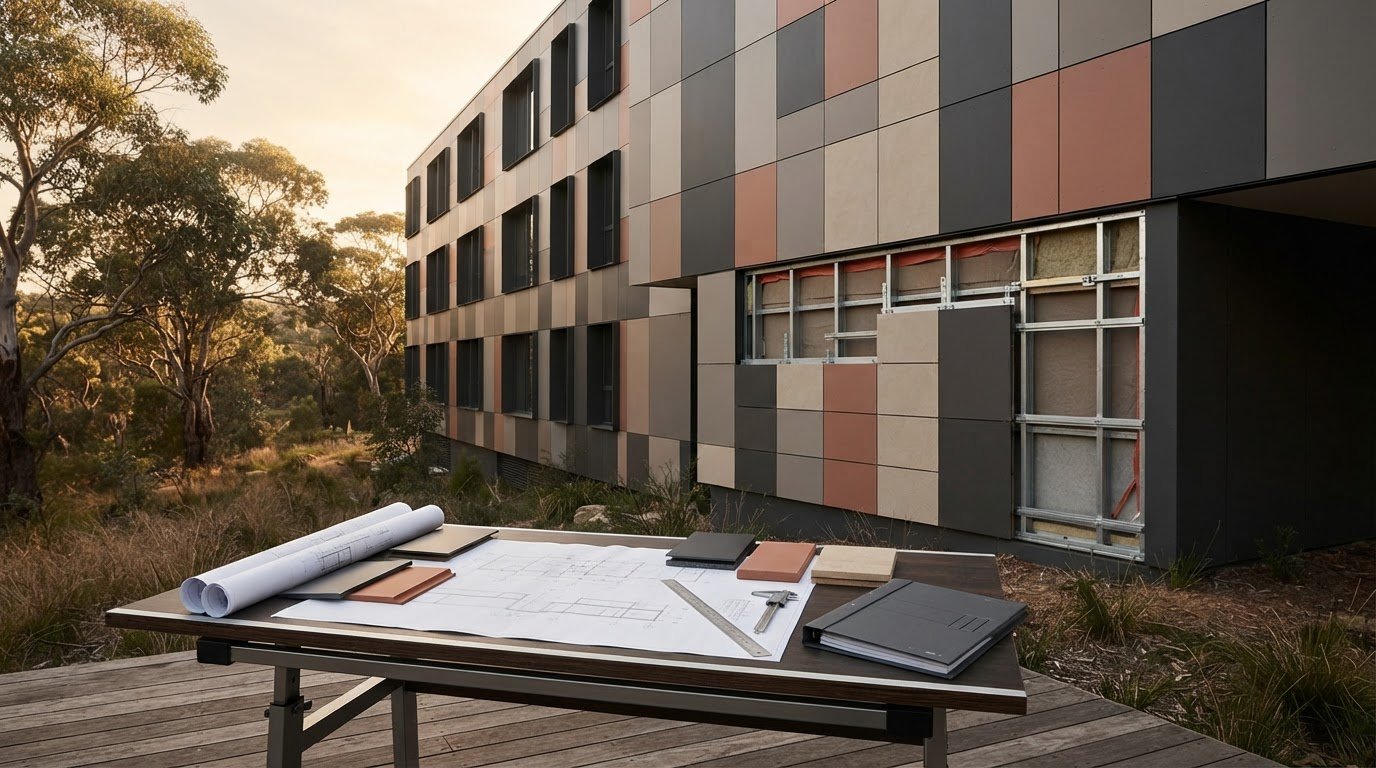
A professional architectural finish is often found in the details you don't see. Using concealed fastening systems allows for a clean, screw-free aesthetic that perfectly mimics traditional timber craftsmanship. Starter clips and matching corner trims are vital; they provide structural support while ensuring that every transition between boards or around windows is crisp and weather-tight. For projects involving integrated outdoor levels, using adjustable pedestals ensures that your decking and cladding align perfectly, creating a unified architectural flow from the ground up. These components aren't optional extras; they're the foundation of a durable facade.
Planning Your Project for Success
Success begins long before the first board is fixed. Calculating quantities correctly is essential, especially for complex facade designs where wastage can vary significantly. While a standard allowance of 5 to 10 percent is typical, intricate vertical layouts or specific shadow line requirements may require more precise planning. Before you begin, it's vital to refer to our technical resources and manuals to understand the specific installation requirements for your chosen range. This oversight ensures that your project meets the structural standards and NCC 2026 compliance we've discussed throughout this guide.
If you're ready to start your next project with a partner that values integrity and performance, contact Paveezzi to discuss your national project requirements.
Elevate Your Facade with Lasting Architectural Integrity
Your facade is the most visible expression of your design vision; choosing a material that balances beauty with technical performance is essential. We've explored how the right composite wood look cladding Australia provides a stable, low-maintenance alternative to traditional timber, especially when engineered to withstand our extreme UV index. By prioritising fully capped technology and ensuring your project meets the latest NCC 2026 and BAL safety standards, you create a building envelope that remains resilient for decades.
Since 2010, our family-run team has provided national supply and architectural support for residential and commercial projects. We know that a professional finish depends on a complete system of concealed fixings and precise profiles like the Ressisto 144 Fineline. This commitment to engineering excellence ensures your home retains its kerb appeal without the burden of constant oiling or repairs. It's about building with confidence alongside a partner you can trust.
It's time to transform your exterior into a durable masterpiece. Explore the Ressisto Architectural Cladding Range today and discover the Paveezzi difference. We look forward to helping you achieve a facade that truly stands the test of time.
Frequently Asked Questions
Does composite wood look cladding fade in the Australian sun?
High-performance composite wood look cladding Australia is engineered with advanced UV-stable pigments to resist the intense local sun. Unlike natural timber that greys off within months, premium capped systems like the Ressisto range feature a co-extruded protective layer. This shield prevents significant colour loss and ensures the facade retains its original warmth. While all materials experience minor weathering over decades, these systems are specifically designed to maintain their aesthetic integrity without the need for staining.
How do I clean and maintain my composite cladding?
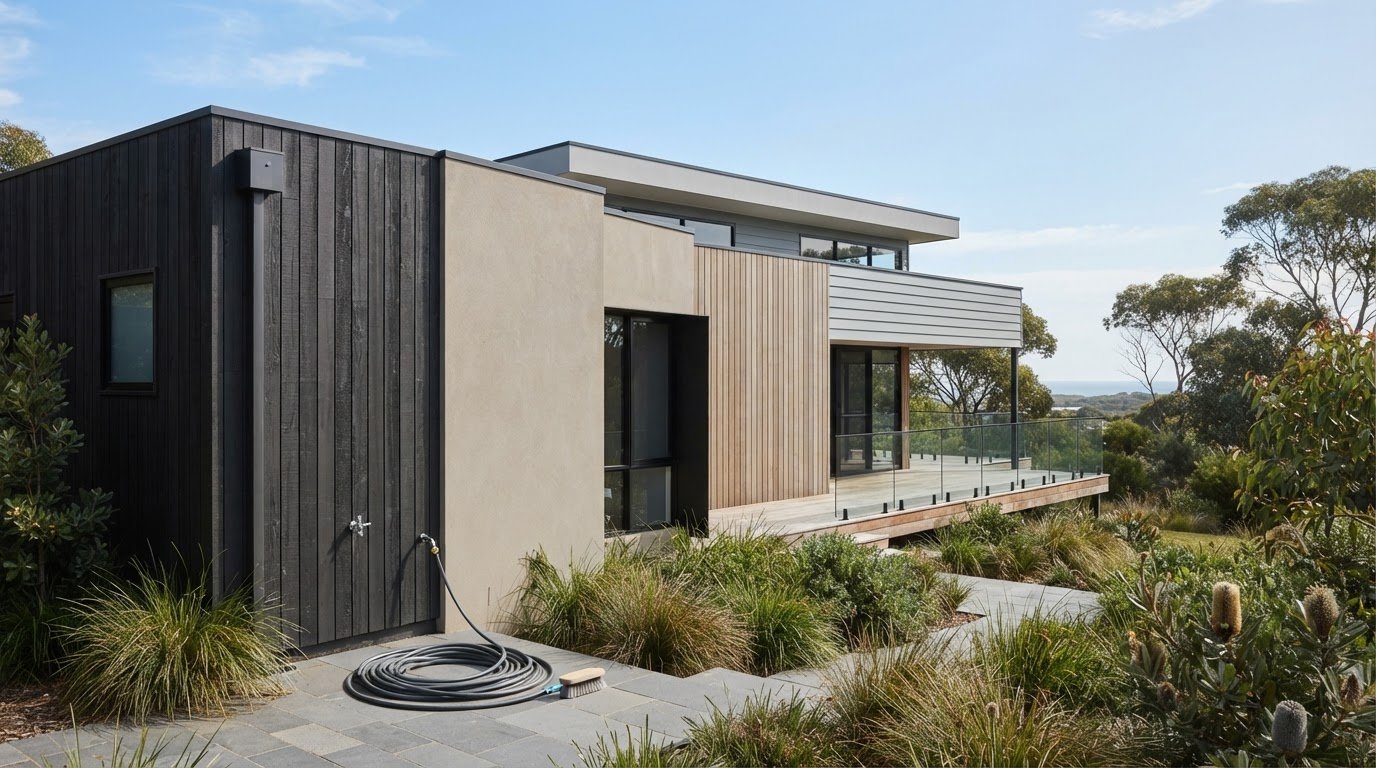
Maintenance is remarkably straightforward and requires no specialised chemicals or equipment. You should simply wash the boards with warm, soapy water and a soft-bristled brush to remove dust or organic debris. There is no requirement for the sanding, oiling, or painting typically associated with timber facades. Because the material is non-porous, it resists most stains and mould growth. This "set and forget" nature allows you to enjoy a pristine architectural finish with minimal effort.
Is composite cladding suitable for bushfire-prone areas (BAL ratings)?
Yes, many of our composite systems are suitable for use in bushfire-prone areas up to BAL-29. These products are rigorously tested against Australian Standard AS 1530.8.1 to ensure they meet the fire propagation requirements of the National Construction Code. It is essential to check the specific certification of your chosen profile, such as the Ressisto 144 Fineline, before beginning construction. We recommend consulting your local building certifier to confirm the exact BAL requirements for your specific project site.
Can I install composite cladding vertically and horizontally?
You can install our architectural ranges in both vertical and horizontal orientations to suit your design vision. Horizontal installation is a classic choice that provides a grounded appearance, whereas vertical installation is increasingly popular for modern luxury homes to create a sense of height. Regardless of the orientation, the system relies on the same concealed fastening technology. This flexibility allows architects to use shadow lines and textures to define the specific character and rhythm of a building.
How does the cost of composite cladding compare to natural timber over 10 years?
While the initial material investment for premium composite wood look cladding Australia is often higher than raw timber, it represents a more cost-effective solution over a decade. Traditional wood requires bi-annual oiling, sanding, and eventual board replacement due to rot or pest damage. When you factor in the cumulative cost of oils, equipment, and labour over ten years, composite systems typically pay for themselves. You gain the added benefit of a facade that remains structurally stable.
Do I need special tools to work with composite cladding boards?
You don't need any specialised machinery to work with our composite systems. The boards can be cut, drilled, and routed using standard woodworking tools like a mitre saw with a fine-toothed blade. Because the material is engineered for precision, it doesn't split or splinter like organic timber, making it easier for builders to achieve clean joins. We always recommend referring to our technical resources to ensure the correct thermal expansion gaps and concealed fixings are used during the process.
Comments