
Fire-Rated Exterior Cladding in Australia: A 2026 Selection Guide
A cladding label alone can’t tell you whether a wall is suitable for your project. A search for “fire rated exterior cladding australia” may return broad claims, but meaningful evidence relates to the tested wall construction and the conditions it covers.
It’s easy to confuse “fire-rated”, “non-combustible” and bushfire-related terms. They describe different aspects of performance, and a result for one product or wall build-up may not apply to another. Project requirements also depend on factors such as the building’s design, use and location.
This guide explains how to interpret common Australian fire-performance terminology, what to look for in test reports, certificates and installation conditions, and how to compare cladding options with your project’s documented requirements. It also covers bushfire exposure and the need to check applicable rules for your state or territory. Paveezzi Composites supplies Ressisto and Lightissimo composite cladding, which can be considered as material options. Assess any fire-performance claim using documentation for the specific product and wall system. Start with the evidence, not the label.
Table of Contents
Fire-rated exterior cladding in Australia: what the terms mean
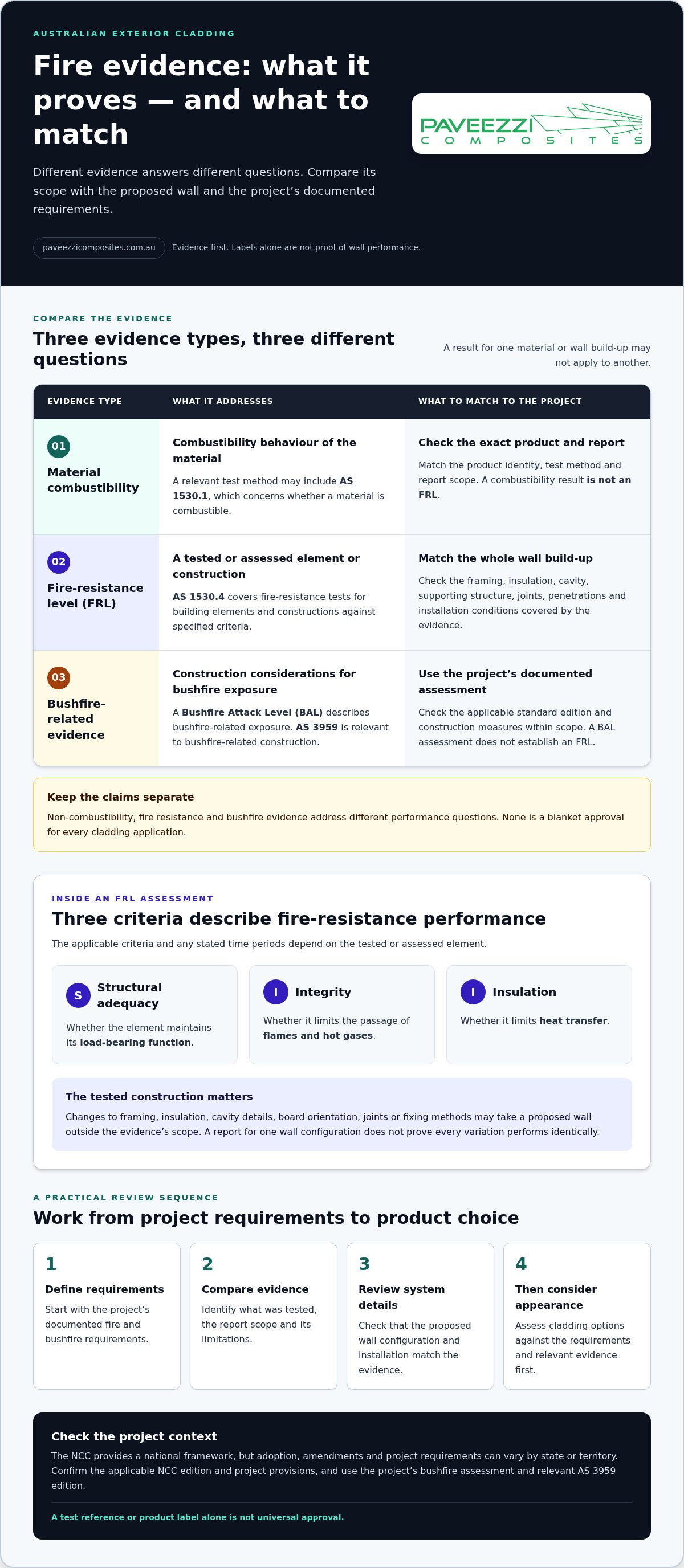
Fire-related labels can sound similar, but they answer different performance questions. “Fire-rated exterior cladding” is a claim that needs relevant test or assessment evidence behind it. A result for a cladding panel alone doesn’t establish how a complete external wall performs.
Fire performance evidence may relate to a material, an element or a complete wall system. A wall system can include the cladding, framing, insulation, cavity and other components, installed in a particular configuration. Evidence is meaningful only within its stated scope, including the tested construction and any conditions or limitations on its use.
The required performance depends on the building’s classification and design, as well as the provisions that apply to the project. The National Construction Code (NCC) provides a national framework, while adoption and project requirements can vary by state or territory. The Australian Building Codes Board (ABCB) is responsible for the NCC. Establish the applicable requirements before comparing products. When reviewing composite cladding options, treat each product as a material to assess against those requirements, not as proof of a wall’s fire performance.
Fire-rated, fire-resistant and non-combustible: how the terms differ
Non-combustibility concerns how a material behaves when tested for combustibility. It doesn’t, by itself, establish a wall’s fire-resistance level. An FRL relates to an element or construction assessed for fire-resistance performance, and applies to the tested or assessed configuration and its stated scope. “Fire-resistant” and “fire-rated” are broad descriptions unless evidence identifies what was tested and what the result covers. Marketing wording isn’t a substitute for that documentation.
Bushfire Attack Level is not a general cladding fire rating
A Bushfire Attack Level (BAL) describes bushfire-related exposure and is associated with construction provisions in AS 3959. It addresses a different question from fire-resistance testing of a building element. A BAL assessment doesn’t establish an FRL, and an FRL doesn’t resolve bushfire requirements. Use the project’s documented bushfire assessment and fire requirements to identify the relevant evidence.
How Australian fire tests and wall-system evidence fit together
Fire evidence answers the question it was designed to test. AS 1530.1 concerns whether a material is combustible, while AS 1530.4 covers fire-resistance tests for building elements and constructions. Neither reference, on its own, is a universal approval for every cladding application. The relevant test method, report scope and project requirements all matter.
Use the distinctions below to identify what a document can establish, and what you still need to compare with the project design.
What an FRL tells you about a tested construction
An FRL describes performance against three criteria: structural adequacy, whether the element maintains its load-bearing function; integrity, whether it limits the passage of flames and hot gases; and insulation, whether it limits heat transfer. The applicable criteria and any stated time periods depend on the tested or assessed element. A report for one wall configuration doesn’t prove that every variation performs identically.
Small differences can matter. Changing the framing, insulation, cavity details, board orientation, joints or fixing methods may take a proposed wall outside the evidence’s scope. Fire evidence applies only when the tested construction and conditions match the proposed wall assembly.
Where the NCC, Australian Standards and BAL fit
The NCC is Australia’s national model building code, but its adoption, amendments and transitional arrangements can vary between jurisdictions. Confirm the applicable NCC edition and project provisions. For bushfire-related requirements, refer to the project assessment and relevant AS 3959 edition. Don’t treat a BAL, one standard or an FRL as a blanket cladding approval. Cladding Safety Victoria provides further context on combustible cladding and government safety measures.
To consider composite materials for a project, view Paveezzi Composites’ range, then assess any fire-performance claim against evidence for the specific product and wall system.
A practical checklist for assessing fire-rated exterior cladding
A sound review starts with the project brief, not a product brochure. Use this checklist to trace each fire-performance claim back to the building requirements and the wall construction it covers.
Start with documented requirements. Identify the project’s fire strategy, building classification and any bushfire assessment. Confirm the applicable NCC edition, jurisdictional provisions and project-specific requirements.
Identify the exact product. Match the name and product details in reports or certificates to the cladding proposed. Similar descriptions or material categories aren’t enough.
Compare the wall build-up. Check the substrate, framing, cavity, insulation, fixings, board orientation and joints against the tested or assessed configuration.
Read the evidence scope. Review the report date, test method, assessment basis, conditions of use, limitations and exclusions. Note any differences between the documented system and the design.
Review installation details. Check that fixing patterns, junctions and permitted installation conditions align with the evidence. Record any departures for resolution in the project documentation.
Examine the whole façade. Include cavity barriers, penetrations, openings, edges, connections and interfaces with adjoining construction. A panel result doesn’t explain how every junction is addressed.
Check the evidence against the fire strategy. Make sure the documents address the relevant NCC provisions and project-specific fire requirements, rather than relying on a general “fire-rated” label.
For each document, ask: Does it apply to this exact product and wall build-up? Are openings, penetrations, barriers and connections covered in the system design? Are its conditions and exclusions consistent with the proposed installation? If any answer is unclear, record the gap and resolve it through the project’s documentation process before relying on the claim.
For broader context, official government guidance on cladding systems outlines cladding considerations, including fire and bushfire-related performance. You can also review the Australian exterior cladding range alongside the architectural composite cladding guide. For fire rated exterior cladding australia projects, assess composite options using relevant product- and system-specific evidence, not assumptions about the material category.
Paveezzi Composites supplies composite cladding, including Ressisto and Lightissimo products. Their product identity and the proposed wall build-up are useful starting points when comparing options with a project’s evidence requirements. The composite cladding and decking range also includes products for residential and commercial applications.
Choosing exterior cladding for your Australian project with confidence
A considered selection process keeps fire requirements, technical evidence and design decisions connected. Work through the project requirements first, then assess the system and appearance. Don’t let a finish or material label lead the decision.
Define the project requirements. Record the applicable fire and bushfire requirements for the building, its use and location.
Compare the evidence. Check that reports or assessments relate to the product and performance question relevant to the project.
Review the system details. Match the proposed wall build-up, junctions and installation conditions to the evidence’s scope.
Consider design. Once the evidence is understood, compare suitable profiles and finishes with the project’s appearance, intended use and maintenance expectations.
Balance fire evidence with design and material requirements
Appearance matters, but the selected finish and profile should remain consistent with the documented wall assembly. A change in product, joint arrangement or installation detail may affect whether the evidence applies, so record the selected configuration clearly. Composite cladding can be part of the shortlist, but assess its suitability using relevant product- and system-specific documentation, not assumptions about composite materials as a category.
This evidence-led approach gives project teams a way to assess fire rated exterior cladding australia projects may require, while keeping design decisions connected to documented requirements. It avoids treating a general product description as proof of compliance or fire performance.
From shortlist to a clearly documented specification
Before finalising the specification, bring the key information together: product identity, wall build-up, evidence references and applicable installation conditions. Compare these details with the drawings and façade junctions. If the design differs from a report’s stated scope, identify the gap and resolve it in the project documentation rather than assuming the evidence extends to the variation.
Paveezzi Composites supplies composite cladding for residential and commercial applications, including Ressisto and Lightissimo products. These products can be considered within the same careful selection process, with performance claims assessed against relevant documentation for the product and proposed system. For further design context, see the commercial exterior cladding guide, or learn about Paveezzi Composites.
Choose your cladding with confidence
A sound cladding decision starts with the project’s documented requirements, then follows the evidence. Non-combustibility, an FRL and bushfire-related evidence address different performance questions, so don’t treat one result or a broad product label as proof for every application. Check that the documentation matches the proposed product, wall build-up and installation details.
This approach gives you a clearer way to assess fire rated exterior cladding australia projects may require, while considering appearance, intended use and maintenance. Composite cladding can be part of the selection process when its fire performance is assessed using relevant product- and system-specific evidence.
Paveezzi Composites is a family-run Australian business established in 2010, supplying composite cladding for residential and commercial applications. Explore Paveezzi Composites’ composite cladding range as you develop your project shortlist. Match the product and wall system to your documented requirements to make a considered selection.
Frequently Asked Questions
What does fire-rated exterior cladding mean in Australia?
It means a fire-performance claim supported by relevant test or assessment evidence. The phrase alone doesn’t identify what was tested or the result. Check whether the evidence applies to a material, a wall element or a complete assembly, and whether its scope matches the proposed construction. For fire rated exterior cladding australia projects, also establish the applicable NCC provisions and state or territory requirements for the building.
Is non-combustible cladding the same as fire-rated cladding?
No. Non-combustibility and fire resistance address different performance questions. A combustibility test for a material doesn’t automatically establish a fire-resistance level (FRL) for a wall. An FRL applies to a tested or assessed element or construction within the evidence’s stated scope. For example, a material test result alone won’t show how a wall assembly performs. Compare the evidence with the building’s requirements rather than relying on either label by itself.
Can composite cladding be used on Australian buildings with fire requirements?
It depends on the specific product, proposed wall construction and requirements that apply to the project. Don’t infer fire performance from the word “composite” or from a material category. Review relevant test reports, assessments or certificates, including their scope, limitations and installation conditions, and check that they match the design. Paveezzi Composites supplies composite cladding for residential and commercial applications. Assess any fire-performance claim using relevant product- and system-specific documentation.
What is the difference between BAL and an FRL?
A BAL relates to bushfire exposure and associated construction considerations addressed by AS 3959. An FRL describes fire-resistance performance for a building element or construction. They aren’t interchangeable: a BAL doesn’t establish an FRL, and an FRL doesn’t answer every bushfire-related question. Depending on the project, one or both may be relevant. Use the documented project assessment to identify what applies, including the relevant standard edition and jurisdictional provisions.
Which documents should I check before specifying exterior cladding?
Review current test reports, certificates or assessments, and identify the product, test or assessment scope, limitations and installation conditions each covers. Compare these details with the proposed substrate, framing, cavity, fixings, joints and façade interfaces. Also establish the NCC provisions and jurisdictional requirements relevant to the project. A report may be technically detailed yet still not apply if its tested construction or permitted installation conditions differ from the proposed system.
Does a cladding fire rating apply to the whole wall?
Not necessarily. Evidence may relate to a material, a product or a tested or assessed wall construction. An FRL generally describes the performance of the element or construction within the report’s scope, not every wall that uses a similar cladding board. Framing, layers, cavities, joints, fixings and installation details can affect whether the evidence applies. Compare the documented configuration with the complete proposed wall system before relying on a stated performance.
Comments