
Moisture Resistant Decking: The 2026 Guide to Australian Waterfront Living
- info512916
- Jun 27
- 10 min read
Why does the promise of a coastal lifestyle so often involve a weekend spent with a sander and a tin of oil? If you're living on the edge of the Pacific or overlooking a backyard pool, you know that the combination of salt spray and relentless humidity is a recipe for warped timber and slippery, dangerous surfaces. Choosing moisture resistant decking isn't just a design preference; it's a necessary defence against a climate that treats traditional wood as a snack. We all want that warm, natural aesthetic, but nobody wants the splintering or the constant upkeep that comes with it.
You can have a deck that maintains its integrity for over 20 years without ever touching a paintbrush. This guide explores how modern engineering has solved the oldest problems of waterfront living through advanced, rot-proof materials. We'll show you how to select high-performance boards that offer superior slip resistance for safety and withstand the harshest coastal zones. From understanding the latest 2026 standards to maintaining a flawless finish with zero sanding, you're about to discover the secret to a permanent outdoor sanctuary.
Table of Contents
Why Moisture is the Greatest Threat to Australian Decks
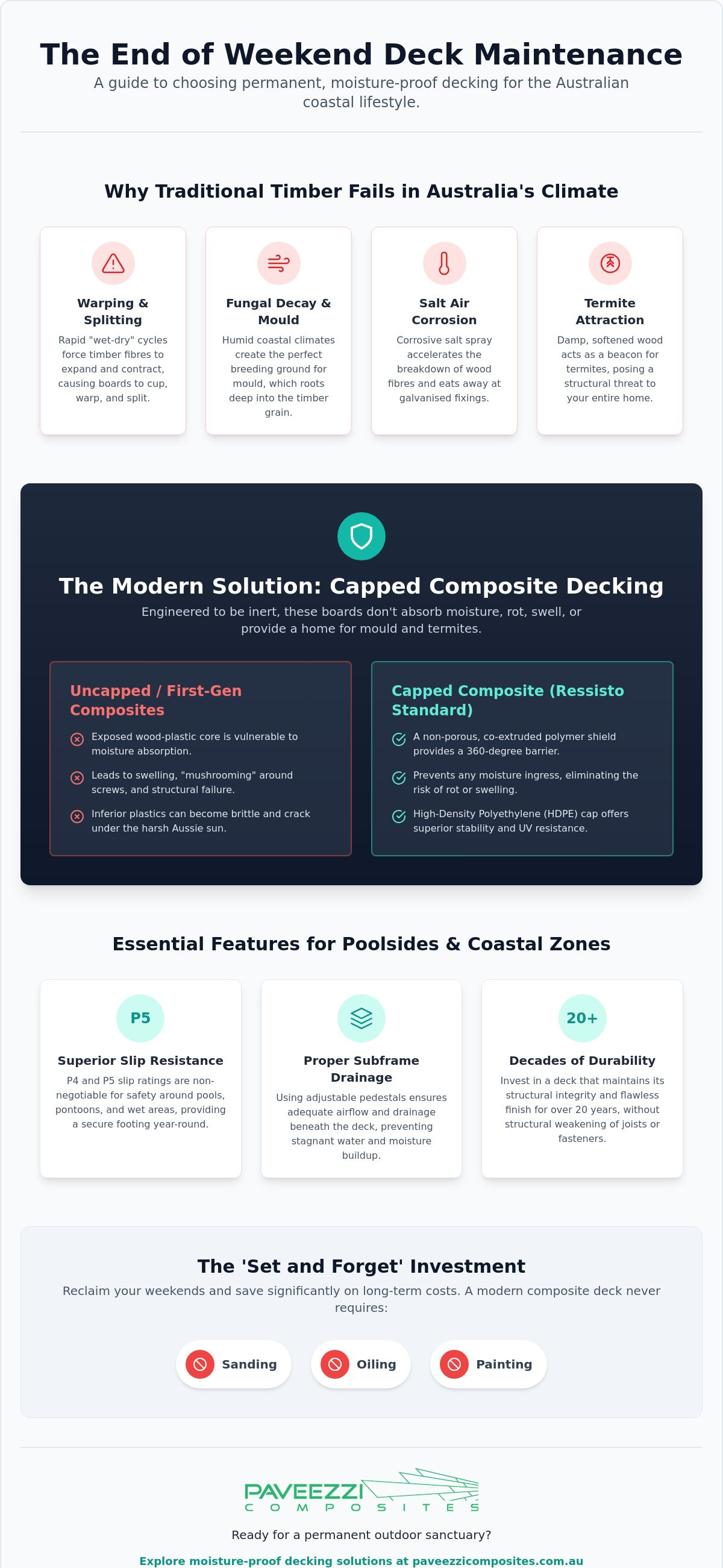
The Australian sun gets the headlines, but it's the moisture that quietly destroys our outdoor spaces. We live in a land of environmental extremes. One hour it's a humid 90 percent, and the next, a dry wind from the interior sucks every drop of moisture out of the air. This rapid "wet-dry" cycle is brutal for natural timber. When wood fibres expand and contract this quickly, the boards begin to cup, warp, and eventually split. It is a physical stress that natural timber was never designed to handle over the long term.
In our humid coastal regions, organic materials act like a giant sponge. This creates a perfect environment for fungal decay. Mould spores don't just sit on the surface; they root deep into the timber grain, making them nearly impossible to remove entirely. For those living near the ocean, salt air adds another layer of complexity. Salt is highly corrosive. It eats away at galvanised fixings and accelerates the breakdown of wood fibres, leading to a deck that looks aged and grey long before its time.
Perhaps the most overlooked danger is the invitation moisture sends to pests. Termites are notoriously attracted to damp, softened wood. A deck that retains moisture isn't just a maintenance headache. It's a beacon for infestation that can eventually threaten the structural integrity of your entire home. Investing in moisture resistant decking ensures your outdoor space remains structurally sound regardless of the humidity levels.
The Limitations of Traditional Timber in Wet Areas
Traditional hardwoods and pressure-treated pine are often sold as durable, but they remain fundamentally hygroscopic. This means the timber naturally attracts and holds water molecules from the surrounding atmosphere, even on days without a cloud in the sky. To combat this, homeowners are forced into a cycle of annual sanding and oiling. If you miss a season, the moisture wins. The cost of this failure is high. Persistent dampness leads to structural weakening of the joists and fasteners, often requiring expensive repairs within just a few years of installation.
Defining True Moisture Resistance in 2026
In the past, "waterproof" simply meant a thick layer of paint or oil. Today, the standard has shifted toward materials that are moisture-proof at their very core. Modern Wood-plastic composites (WPCs) have revolutionised the industry by encasing recycled fibres in high-density polymers. This engineering eliminates the absorption problem entirely. At Paveezzi, we focus on moisture resistant decking that does not support organic growth. Our materials are designed to be inert. They won't rot, they won't swell, and they certainly won't provide a home for mould or termites. It's a fundamental shift from managing decay to preventing it altogether.
The Science of Capped Composite: Ressisto vs. Cheap Alternatives
Not all composite boards are created equal. While many products on the market claim to be moisture resistant decking, the reality often lies in the engineering of the outer layer. Capping is a sophisticated polymer shield that is co-extruded with the composite core during manufacturing. This process creates a molecular bond that is virtually inseparable, providing a non-porous barrier against the elements. Without this shield, a deck is essentially an open invitation for water to seep into the internal fibres, leading to the very swelling and rot you're trying to avoid.
The material used in this cap makes all the difference. Many budget-friendly alternatives rely on inferior PVC or low-grade plastics that can become brittle when exposed to the harsh Australian sun. In contrast, the Ressisto range utilises high-density polyethylene (HDPE). This choice of material offers superior stability and a higher melting point, ensuring the protective barrier remains intact even during a blistering Sydney summer. You can explore our Ressisto 138 Extra Matte range to see how this technology translates into a surface that feels like natural timber but behaves like an engineered fortress.
Capped vs. Uncapped: Why the Shield Matters
First-generation composites were often uncapped, meaning the wood-plastic mixture was exposed on all sides. Over time, these boards would absorb moisture, leading to "mushrooming" around the fasteners and significant structural failure. Modern moisture resistant decking must feature 360-degree capping. This ensures that no moisture ingress occurs from the sides or the bottom of the board, which is particularly vital for low-ground decks where ventilation is limited. By protecting the entire profile, we prevent the core from ever coming into contact with standing water or damp subframes.
Advanced Surface Technology: Extra Matte and Brushed Textures
A common concern with high-performance surfaces is that they might look "plastic" or become slippery when wet. Our surface engineering solves both problems simultaneously. The Ressisto 143 Brushed finish provides a deeply textured, raw timber feel that actively breaks up water tension. This prevents "puddling" on the deck surface, allowing moisture to disperse and evaporate more efficiently. Similarly, our Extra Matte finishes reduce the harsh glare often associated with synthetic materials while maintaining a non-porous surface that won't harbour mould or salt crystals.
Choosing a board with the right technical specifications ensures your investment remains beautiful for decades. If you're ready to see the difference for yourself, you can browse our full range of high-performance decking solutions designed for the Australian coast.
Designing for High-Moisture Areas: Pools, Pontoons, and Coastal Facades
Australian waterfront living demands more than just aesthetic appeal; it requires a design that can withstand constant saturation. Whether you're planning a pontoon on the Gold Coast or a backyard pool in Perth, the material you choose must handle the relentless presence of water without compromising safety or structural integrity. Moisture resistant decking has become the gold standard for these environments because it addresses the physical challenges that timber simply cannot meet. In coastal zones, traditional wood often suffers from "salt-caking," where salt crystals lodge in the grain and expand, causing the surface to flake and deteriorate. High-performance composites are non-porous, meaning salt and water stay on the surface where they can be easily rinsed away.
Vertical surfaces are equally vulnerable to the elements. For those looking to protect their entire home, read our guide on architectural facade systems to understand how vertical moisture protection can prevent dampness from reaching your home's structural frame. Integrating these systems ensures a cohesive, durable exterior that maintains its colour and strength for decades.
Optimal Drainage and Airflow
A successful deck design prioritises what happens beneath the surface. Trapped moisture is the primary cause of subframe rot, which is why we recommend using Rhino adjustable pedestals to create a level, ventilated foundation. These pedestals are particularly effective for low-clearance decks over concrete slabs, as they allow water to flow freely to the drains rather than pooling under your boards. Maintaining a consistent gap between boards is also critical; it facilitates moisture evaporation and prevents the "sauna effect," where rising dampness from the ground gets trapped and accelerates decay. In the humid climates of tropical Australia, this airflow is the difference between a deck that lasts and one that fails prematurely.
Slip Resistance and Safety Standards
Safety is non-negotiable in wet areas. In Australia, slip resistance is measured using the P-rating system, and for poolside applications, a P4 or P5 rating is the industry benchmark for safety. The brushed texture of our Ressisto 143 range is specifically engineered to provide superior grip even when the surface is fully saturated. Beyond traction, composite decking offers a significant safety advantage for families; it's completely splinter-proof, making it much safer for bare feet around pools compared to traditional timber that has been weathered by the sun and water. Choosing a compliant, high-traction surface ensures your outdoor space is as safe as it is beautiful.
To start building a safer, more durable outdoor space, you can view our full range of moisture-proof solutions today.
Maintenance and Longevity: The "Set and Forget" Investment
The decision to install a deck is an investment in your lifestyle, but the true cost of that investment only becomes clear after the first few summers. Traditional timber decks are notorious for their hidden costs. When you factor in the price of high-quality oils, sander hire, and the value of your own time, maintaining a hardwood deck over a decade can easily cost thousands of dollars. By choosing moisture resistant decking, you eliminate the need for this exhausting cycle. The "set and forget" reality means your weekends are spent enjoying the view rather than scrubbing on your hands and knees with a paintbrush.
Long-term performance is built into the chemistry of the boards. Unlike timber, which inevitably fades and cracks under the intense UV radiation of the Australian sun, our engineered composites are designed to retain their structural integrity and colour. This stability is vital for waterfront properties where reflection from the water doubles the exposure. Keeping your deck looking pristine is surprisingly simple. Most salt, sand, and organic debris can be removed with nothing more than warm soapy water and a soft-bristled broom. It is a straightforward process that keeps the surface non-porous and free from salt-caking.
Simple Care for a Lifetime of Use
While our boards are incredibly durable, a basic annual cleaning routine ensures they look as good as the day they were installed. It is vital to remember that you should never use a high-pressure washer on composite materials. The intense force can damage the protective capping and potentially void your warranty. Instead, focus on managing natural elements like tannins from fallen leaves or pollen from nearby bushland. If left to sit in high humidity, these organic materials can create surface stains. For a step-by-step breakdown of how to handle specific spills or seasonal care, check out our resources page for detailed maintenance guides.
Why Quality Matters: Avoiding the "Cheap Import" Trap
The market is currently flooded with low-cost, hollow-core composites. These products are a significant risk in high-moisture areas. Hollow channels can trap condensation and salt air; this leads to internal mould growth that is impossible to clean or treat. Paveezzi’s solid-profile boards offer much better thermal stability and total moisture rejection. As a family-run Australian pioneer, we understand the specific demands of our local climate. We don't just sell products; we provide the expertise needed to ensure your project succeeds. If you are ready to upgrade your outdoor living, contact the Paveezzi team today to request samples for your next project.
Secure Your Waterfront Sanctuary for Decades to Come
Transitioning to a high-performance outdoor space means moving beyond the limitations of traditional materials. By prioritising advanced capping technology and integrated drainage systems, you're not just building a deck; you're securing a maintenance-free sanctuary. We've explored how the right moisture resistant decking can withstand the harshest coastal conditions while maintaining the natural beauty of timber without any of the associated rot, warping, or splintering. It's about making a choice that respects your time and your lifestyle.
Paveezzi has been a dedicated, family-run Australian business since 2010. We take immense pride in our heritage as trusted pioneers in the industry. Our architectural grade Ressisto series is specifically engineered for the unique Australian climate, ensuring that your project survives the humidity and salt spray of our coastal zones. We remain committed to excellence and long-term performance in every board we produce, providing a stable and knowledgeable ally for your construction journey.
Ready to transform your outdoor area with boards that are as durable as they are beautiful? Browse our range of moisture-resistant composite decking and see the difference that meticulous engineering makes. Your permanent outdoor sanctuary is just a step away.
Frequently Asked Questions
Is composite decking completely waterproof?
Capped composite decking is essentially moisture-proof for residential use, although no building material is entirely "waterproof" if submerged indefinitely. The advanced polymer shield that surrounds the core prevents water from reaching the organic fibres inside. This stops the boards from swelling, rotting, or cupping even during heavy tropical downpours. It's a far more stable alternative to traditional timber that naturally absorbs water from the air.
Does moisture resistant decking get slippery when wet?
Slip resistance depends on the specific surface texture and its Australian P-rating. High-quality moisture resistant decking, like our Ressisto 143 Brushed range, is engineered with deep textures to achieve a P4 or P5 rating. This ensures a secure grip even when the surface is fully saturated by pool water or rain. It's often safer than timber, which can become slimy when algae grows in the wood grain.
Can I use composite decking for a boat ramp or pontoon in Australia?
Yes, capped composite is an ideal choice for pontoons and marine environments because it handles constant exposure without degrading. Unlike timber, it won't splinter or warp when exposed to the tidal "wet-dry" cycle. Its resistance to salt and rot makes it a durable, low-maintenance alternative for Australian waterfront structures. You'll just need to ensure your substructure is also rated for marine use to match the deck's longevity.
How does salt spray affect composite decking compared to timber?
Salt spray has almost no effect on the polymer shield of a capped composite board because the material is non-porous. In contrast, salt crystals lodge in the grain of timber, expanding as they dry and causing the wood to flake and weaken over time. Because composite doesn't absorb the salt, it remains on the surface. You can simply rinse it off with a hose to prevent any abrasive salt-caking.
Do I need to seal the ends of composite decking boards to prevent moisture ingress?
You should always use an end-sealer on any cut ends of your boards during the installation process. While the top and sides are protected by the polymer cap, a cut exposes the composite core to the elements. Sealing these ends prevents moisture from wicking into the centre of the board, which protects against internal swelling. It's a simple step that ensures your deck reaches its full 20-plus year lifespan.
Can composite decking grow mould or mildew in humid climates?
The boards themselves don't provide a food source for mould, but organic debris like pollen or dirt can settle on the surface and grow mildew. Because the material is non-porous, this growth stays on the surface rather than rooting deep into the grain. A quick wash with soapy water and a soft broom usually removes any surface mould. It's much easier to manage than mould that has colonised the interior of timber.


Comments