
The Complete Checklist for Choosing a Decking Pedestal System in Australia
- info512916
- Jun 23
- 10 min read
Table of Contents
What is a Decking Pedestal System and Why Use One in Australia?
A decking pedestal system is a highly engineered foundation solution designed to create a perfectly level, stable, and durable subframe for elevated decks. Often referred to as deck jacks or adjustable pods, this system uses a series of height-adjustable supports to raise joists off a solid substrate like concrete, effectively creating a ‘floating’ deck. This approach bypasses the need for traditional timber stumps or bearers fixed directly to the ground.
The primary advantage is its unparalleled ability to achieve a flawless, level finish over uneven or sloping surfaces. In Australia, where concrete slabs on balconies, rooftops, and patios often have built-in falls for drainage, a decking pedestal system is not just a convenience—it's an essential engineering tool. It allows builders to create a perfectly horizontal deck surface while preserving the crucial slope of the underlying slab. Furthermore, Australia's climate, with its high humidity and periods of intense rainfall, makes traditional ground-level timber subframes vulnerable to moisture absorption, rot, and termite attack. By elevating the joists, a pedestal system promotes critical airflow, preventing moisture from becoming trapped and significantly extending the life of the entire structure. On balconies and rooftops, pedestals play a vital role in protecting expensive waterproof membranes from being punctured by fasteners, ensuring the building's long-term integrity.
The Anatomy of a High-Quality Deck Jack
While simple in concept, a high-quality deck jack is a product of precise engineering. Understanding its components is key to appreciating its function and selecting the right system for your project.
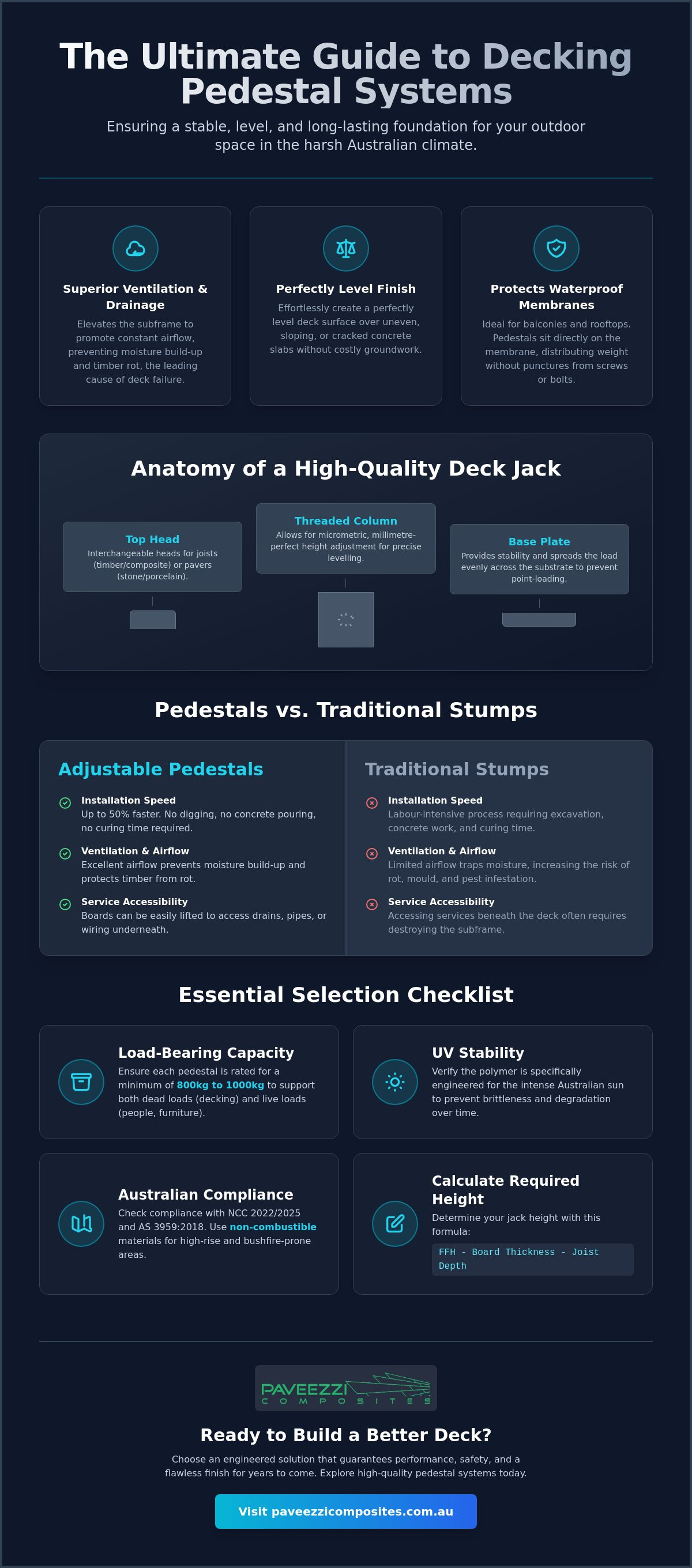
The Base Plate: This is the foundation of the pedestal. A wide, stable base plate is crucial for distributing the load evenly across the substrate. This prevents point-loading that could damage the surface below, particularly sensitive waterproof membranes. Quality base plates often feature perforations for drainage and options for mechanical fixing if required.
The Threaded Column: The core of the system’s adjustability, the threaded column allows for micrometric, or millimetre-perfect, height adjustment. This precision is what enables installers to compensate for slab imperfections and create a perfectly level plane for the joists. A robust, easy-to-turn thread is a hallmark of a superior pedestal.
Joist Cradles vs. Paver Heads: The head of the pedestal is the interface between the support and the surface material. For decking, a joist cradle is used. This U-shaped head securely holds timber or aluminium joists, preventing movement. For tiled patios, a paver head with spacer tabs is used instead. Ensuring you have the correct head for your chosen application is fundamental.
Pedestals vs. Traditional Stumps: A Comparison
When compared to traditional methods like timber or concrete stumps, adjustable pedestals offer a clear set of advantages that modernise the deck-building process. For builders and homeowners across Australia, the benefits translate to better performance, faster installation, and long-term peace of mind.
Speed of Installation: The efficiency of a pedestal system is transformative. Without the need for digging, pouring concrete footings, or complex joinery, installers can cut labour time by up to 50%. Adjustments are made by simply rotating the threaded column, a process that is significantly faster than packing and trimming traditional stumps.
Ventilation Benefits: Trapped moisture is the enemy of any decking material. Pedestals create a crucial air gap between the slab and the joists, facilitating constant under-deck airflow. This ventilation helps prevent the "cupping" and distortion often seen in composite decking boards by allowing moisture to evaporate evenly from all sides.
Access for Maintenance: The floating nature of a pedestal deck provides a significant long-term benefit: access. Drains, pipes, and other services concealed beneath the deck remain accessible. If a repair is needed, specific sections of decking can be lifted to reach the area without having to dismantle the entire subframe.
The Essential Selection Checklist: Finding the Right System
Choosing the right decking pedestal system in Australia requires more than just finding the right height. It demands a careful evaluation of load capacity, material science, and environmental resilience. This checklist provides a professional framework for making an informed decision.
Load-Bearing Capacity: This is non-negotiable. Your system must be engineered to handle significant weight. Look for pedestals independently tested and rated for a compressive load of at least 800kg–1000kg per unit. This ensures the foundation can safely support not only the deck itself but also heavy furniture, large gatherings, and planter boxes.
Height Range: Before you buy, measure the distance from your substrate to your desired finished deck height at multiple points. Identify the lowest and highest clearance points. Your chosen pedestal system must have a height range that comfortably covers this entire span, ideally without being at the absolute minimum or maximum of its extension.
UV Stability: Australia’s intense UV radiation can degrade inferior plastics over time, making them brittle. Verify that the pedestals are made from high-grade, UV-stabilised polypropylene or a similarly robust polymer. This ensures the material will not crack or fail after prolonged sun exposure, guaranteeing the structural integrity of your deck for decades.
Chemical Resistance: If your deck is near a saltwater pool, located in a coastal area, or will be cleaned with specific chemicals, material resistance is critical. High-grade polypropylene offers excellent resistance to salt, chlorine, and common acids, making it a reliable choice for challenging environments.
Compatibility: The joist cradle must be a perfect fit for your chosen joists. Measure the width of your timber or composite decking joists and check it against the pedestal manufacturer's specifications. A snug fit prevents rocking and ensures a rigid, stable subframe.
Step 1: Calculate Your Required Height Clearance
Accurate measurement is the first step to a successful installation. Start by determining the "Finished Floor Height" (FFH)—the final height you want the top surface of your deck to be. This is often aligned with an internal floor level for a seamless indoor-outdoor transition. From the FFH, subtract the thickness of your decking boards and the depth of your joist. For example, if you are using Paveezzi’s Ressisto 143 Brushed boards (23mm thick) with a 40mm deep joist, you would subtract 63mm from your FFH to find the required height of your pedestal. Always choose a system with available "extension couplers." These allow you to safely and securely increase the height of a pedestal, providing a future-proof solution for projects with deep voids or significant height variations.
Step 2: Evaluate Environmental Factors
A pedestal system must be specified to match its environment. A deck in a protected urban courtyard faces very different challenges to one on an exposed coastal balcony.
Corrosion and Climate: Is the project in a high-corrosion coastal zone? If so, high-grade polypropylene is an excellent choice due to its inertness. For non-combustible applications, powder-coated aluminium or galvanised steel systems offer superior corrosion resistance.
Load and Traffic: Will the deck be subject to high foot traffic, as in a commercial setting? Or will it need to support exceptionally heavy items like a spa pool or large, soil-filled planter boxes? In these scenarios, you may need to decrease the spacing between pedestals to increase the number of support points and distribute the load more effectively. Always consult the manufacturer's span tables.
Acoustics and Vibration: On residential balconies and rooftops, noise transmission can be a concern. The sound of footsteps or furniture moving can travel through the structure. To mitigate this, look for systems that incorporate anti-vibration or acoustic dampening pads. These rubber shims are placed on the head or base of the pedestal to absorb vibrations and reduce noise.
Australian Compliance: Fire Ratings and Slope Correction
Navigating Australian building codes is a critical part of specifying any building material, and pedestal systems are no exception. Recent updates to the National Construction Code (NCC) have placed a strong emphasis on fire safety, particularly for multi-residential and commercial buildings (Class 2-9). This has driven a shift towards non-combustible materials for external components, including decking subframes on balconies.
It is now essential to specify aluminium or steel pedestals over traditional polymer systems in many high-rise and commercial applications to meet these stringent non-combustible requirements. Beyond fire safety, a key compliance issue is managing water. Almost every concrete slab is built with a slope for drainage. A professional pedestal system must correct for this slope to create a level deck surface while allowing water to drain away underneath, ensuring your system doesn’t void the building’s waterproofing warranty by trapping water.
Non-Combustible Adjustable Pedestals for High-Rise Safety
Understanding the terminology is vital. "Fire-retardant" materials are treated to slow the spread of flame, but they will eventually burn. "Non-combustible" materials, like aluminium and steel, will not burn and do not contribute to a fire. For projects governed by strict fire safety codes, this distinction is everything. Paveezzi focuses on providing fully non-combustible solutions for architects and builders working on commercial and high-rise projects, ensuring compliance with the rigorous demands of the AS 1530.1 standard. When specifying a pedestal system for any balcony or rooftop on a Class 2-9 building in Australia, verifying its compliance with this standard is a mandatory step.
Self-Levelling Heads and Slope Compensation
A flat deck on a sloped slab is achieved in one of two ways: manually with sloped shims, or automatically with a self-levelling head. Modern, high-end pedestal systems feature self-levelling heads that can automatically compensate for slopes of up to 5%. This pivoting head ensures the joist cradle remains perfectly horizontal, even when the pedestal base is on an angle. This is not just about creating a level walking surface; it’s about structural integrity. By keeping the head level, it ensures the load from the joist is always transferred vertically down through the centre of the pedestal column. This prevents eccentric loading, which can place undue stress on the pedestal and the joist system, ensuring a stable and secure foundation for the life of the deck.
Planning Your Build: Installation and Maintenance Tips
Proper planning is the foundation of a successful pedestal deck installation. A methodical approach ensures stability, minimises waste, and delivers a professional finish. Before laying the first pedestal, create a simple layout plan. It’s almost always best to start from the highest point of the slab and work outwards and downwards, as this gives you a fixed reference point for the rest of the deck height.
Your plan should also map out pedestal spacing. For residential projects with standard loads, joist spans are typically around 450mm centres, with pedestal spacing along the joist also at 450mm. For commercial projects with higher anticipated loads, these spans should be reduced. Always consult the engineering specifications for your chosen joist material. Regarding fixing, most residential applications on a stable concrete slab allow for the pedestals to be "loose laid." The weight of the deck and joists provides sufficient stability. However, in high-wind areas or on very high elevations, mechanically fixing the base of some pedestals to the slab with approved fasteners may be required for additional security. Finally, before the decking boards go down, walk the entire subframe. Check for any "bounce" (indicating a joist span is too large) or "clatter" (indicating a pedestal needs a final micro-adjustment). This final check ensures a perfectly solid feel underfoot.
Integrating with RHINO Pedestal Systems
For Australian architects and discerning builders, Rhino Adjustable Pedestals have become a preferred choice. Their robust engineering, extensive height range, and compliance-focused options provide a reliable foundation for high-end decking projects. Achieving a seamless, architecturally clean look is about integrating every layer of the build. By pairing a Rhino pedestal foundation with premium decking like our Ressisto 138 Extra Matte boards, you ensure the quality of the finish is matched by the integrity of the structure beneath. For complex projects, such as balconies with multiple drainage points and varying slopes, the Rhino Self-Levelling range is indispensable. It simplifies the installation process, automatically correcting for gradients and ensuring a perfect result with less labour.
Long-Term Performance and Care
One of the most compelling reasons to choose a pedestal system is the dramatic reduction in long-term maintenance compared to a traditional timber subframe. With no ground contact, the risks of rot and termites are virtually eliminated. The components themselves—whether high-grade polymer or coated aluminium—are inert and require no ongoing treatment or sealing. The primary care requirement is simple: ensure the drainage points beneath the deck remain clear. The gaps between decking boards allow for inspection, and any accumulation of leaves or debris around drains can be easily cleared to prevent water from backing up. This simple, periodic check is all that’s needed to ensure your deck's foundation continues to perform flawlessly for years to come.
For more inspiration on how a well-designed foundation contributes to a stunning final product, explore our guide to luxury composite decking in Australia.
Frequently Asked Questions (FAQs)
Can I use a pedestal system on a dirt or grass surface?
No, adjustable pedestal systems are designed for use on hard, stable, and load-bearing surfaces like concrete slabs, waterproofed rooftops, or well-compacted road base with paving stones. Placing them directly on soil or grass will lead to subsidence and an unstable deck.
How many pedestals do I need per square metre of decking?
The number varies depending on the joist spans and the load requirements of your project. A common residential specification with joists at 450mm centres and pedestals spaced every 450mm along the joist would require approximately 5 pedestals per square metre. However, for commercial or high-load areas, this density will increase. Always refer to the manufacturer's guidelines.
Are adjustable pedestals safe for high-rise balconies in Australia?
Yes, but only when the correct type is specified. For high-rise residential (Class 2) and commercial (Class 3-9) buildings, you must use a non-combustible pedestal system made from aluminium or steel to comply with the National Construction Code (NCC) and AS 1530.1 fire safety standards.
Can I use pedestals with timber joists or only aluminium?
Pedestals are compatible with both treated timber joists and aluminium or steel joists. The key is to ensure the joist cradle on the pedestal head is the correct width to securely hold your chosen joist material.
Do pedestals need to be bolted down to the concrete slab?
In most residential, low-level applications, the weight of the deck structure is sufficient to hold the loose-laid pedestals in place. However, for high-rise balconies, in high-wind zones, or where significant lateral forces are expected, mechanical fixing of some or all pedestal bases is recommended for additional stability and safety.
What is the maximum height an adjustable pedestal system can reach?
This varies significantly between brands, but professional-grade systems can safely reach heights of over 1000mm (1 metre) with the use of extension couplers and appropriate bracing for stability at extreme heights. Always check the manufacturer's technical data sheet for maximum height limits and any required bracing specifications.


Comments