
The Ultimate Buyer’s Checklist for Premium Wood Alternative Cladding in 2026
- info512916
- Jun 20
- 12 min read
What if the most expensive part of your new facade isn't the initial purchase price, but the hidden cost of maintenance you are forced to start in just two years? It is a frustrating reality for many who choose traditional timber, only to watch the brutal Australian sun warp and bleach their investment. You likely want the timeless, architectural aesthetic of wood without the relentless cycle of oiling, staining, and worrying about fire compliance. Selecting premium wood alternative cladding is no longer just about picking a pretty board; it is about conducting a technical audit of a performance-engineered system.
We've designed this checklist to ensure your project remains beautiful and fully compliant with the latest NCC 2025 standards. As states like Western Australia and the ACT move through their transition periods, understanding new mandates for condensation management and non-combustible materials is vital. You will discover exactly how to evaluate core durability and colour retention technology. We will guide you through the essential quality markers that separate a standard composite from a lasting architectural statement.
Key Takeaways
Learn how to distinguish between basic composite products and high-performance wood-plastic systems engineered for architectural longevity.
Understand the critical fire safety and BAL rating requirements necessary to comply with the latest NCC 2025 building standards.
Utilise our professional 5-step selection checklist to audit the material composition and capping thickness of premium wood alternative cladding systems.
Discover why 360-degree capping and advanced UV stability are the most important factors for a maintenance-free facade in the harsh Australian sun.
Explore the latest 2026 design trends, including the popular Fineline aesthetic and how to choose between brushed or matte surface finishes.
Table of Contents
What Defines Premium Wood Alternative Cladding in Australia?
The evolution of building materials in Australia has reached a significant turning point. While early iterations of composite materials often struggled with a "plastic" appearance and questionable durability,Paveezzi Composites modern premium wood alternative cladding represents a complete departure from those first-generation products. These are no longer just decorative boards. They are performance-engineered systems designed to withstand some of the harshest environmental conditions on the planet. The industry has moved beyond simple "plastic wood" to create sophisticated architectural facades that satisfy both the aesthetic demands of designers and the practical needs of homeowners.
Cladding serves as the primary skin of a building, providing weather resistance and thermal insulation while defining its character. In Australia, the intense UV radiation and extreme temperature fluctuations mean that standard materials often fail prematurely.
A premium system addresses these challenges through advanced material science, focusing on thermal expansion control and structural integrity. By investing in higher-grade premium wood alternative cladding now, you effectively lower the long-term lifecycle costs of a residential build by avoiding the replacement and repair cycles common with inferior products.
The Science of High-Performance Composites
At the core of these systems is a precise ratio of recycled wood fibres and high-density polymers. This blend provides the natural look of timber with the strength of modern synthetics. The most critical advancement is 360-degree capping technology. This protective outer layer acts as a shield, preventing moisture ingress and stopping fungal decay before it can start. Without this barrier, moisture can seep into the core, leading to the swelling and rot seen in older composite generations. High-performance pigments are also baked into the material to ensure the facade retains its depth of colour, even after years of exposure to the relentless Australian sun.
Timber Aesthetics Without the Maintenance Burden
Choosing an alternative doesn't mean sacrificing the sensory appeal of natural wood. Modern manufacturing techniques allow for brushed and matte finishes that mimic the tactile grain of timber. It is a sophisticated look that remains consistent over time. You can achieve the sought-after "Shou Sugi Ban" charred timber look with the peace of mind that comes from modern durability.
Zero Oiling: You can finally retire the brushes and tins of expensive oils.
No Sanding: The surface remains stable without the need for periodic resurfacing or messy sanding.
Architectural Style: Profiles are designed with clean lines to suit contemporary Australian architecture.
The result is a facade that looks as striking in a decade as it does on the day of installation. You get to spend your weekends enjoying your home rather than maintaining it.
Critical Performance Standards for External Facades
Selecting premium wood alternative cladding requires more than an eye for design. It demands a rigorous understanding of how materials behave under duress. The Australian environment is notoriously unforgiving. Between the extreme UV index of the northern states and the freezing cycles of the southern highlands, a facade must do more than look good. It must remain structurally sound and legally compliant. Performance standards are not merely suggestions. They are the benchmarks that ensure your investment doesn't become a liability within a few short years.
Fire safety remains the most critical consideration for any modern build. The Building Code of Australia (BCA) provides the framework for these safety benchmarks, particularly regarding fire rated and non-combustible materials. As of May 2026, the adoption of NCC 2025 in territories like the ACT and Western Australia has tightened these requirements further. You must verify that your chosen cladding meets the specific Bushfire Attack Level (BAL) required for your site. High-performance composites offer an inherent biological advantage here too. They are naturally resistant to termites and rot, eliminating the need for the toxic chemical treatments often required for natural timber.
UV resistance is another non-negotiable factor. While many products claim to be "UV stable," the reality on an Australian job site is often different. True stability means the material won't just retain its colour; it will maintain its molecular integrity. Inferior products often become brittle or chalky after a few summers. By choosing premium wood alternative cladding with advanced capping technology, you ensure the boards resist warping and cupping even when the mercury hits forty degrees. If you're unsure which rating your specific climate zone requires, our team can help you explore compliant facade solutions for your next build.
Navigating Australian Fire and Safety Compliance
Architects must look closely at AS 1530.1 and AS 1530.3 testing results. These standards determine how a material reacts to heat and flame spread. For Type A and B constructions, the shift toward non-combustible wall panels is now a mandate under the latest regulations. Safety extends to the entire wall assembly. This includes using non-combustible subframes and non-combustible adjustable pedestals to ensure the entire system meets the necessary fire engineering criteria.
Thermal Expansion and Moisture Control
Precision engineering allows premium systems to manage the natural expansion and contraction that occurs across the seasons. Without this control, facades can suffer from "oil canning," where panels appear buckled or wavy. The NCC 2025 now mandates drained and ventilated cavities for climate zones 6, 7, and 8. This move prevents moisture entrapment and condensation. A ventilated facade system ensures that even if moisture bypasses the primary skin, it can escape without causing structural damage or mould growth.
Aesthetic Evaluation: Profiles, Colours, and Finishes
Visual appeal is often the primary catalyst for choosing premium wood alternative cladding. While technical durability remains the backbone of any build, the aesthetic finish defines the home's character and street presence. In 2026, we are seeing a distinct move toward bolder, more intentional scale in facade design. The choice between a standard width and a wider profile significantly alters the building's perceived volume and texture. For instance, utilizing a wider board like the Ressisto Lightissimo 400 offers a grand, expansive feel that suits large residential volumes. Conversely, narrower profiles create a detailed, intricate rhythm that draws the eye toward specific architectural features.
The rise of the "Fineline" aesthetic has become a hallmark of modern Australian design. It provides a clean, linear shadow line that mimics high-end timber battening without the structural risks of individual timber pieces twisting or splitting. This look is particularly effective for creating contrast. You might use it to highlight an entrance portico or a cantilevered upper level. Modern colour palettes have also expanded far beyond basic brown. We now see a high demand for weathered silver-grey tones that evoke a coastal driftwood feel, as well as deep, charred blacks that provide a sophisticated, contemporary edge.
Architectural Profiles for Modern Design
Vertical installation is currently dominating the architectural landscape. It creates a sense of height and verticality that feels incredibly fresh. Horizontal layouts remain a classic choice for grounded, sprawling coastal homes where the design language is about mirroring the horizon. Both styles rely on concealed fixing systems to maintain a pristine, fastener-free appearance. Understanding how architectural composite cladding can be utilised to enhance property value is a key step for any developer. It allows for a cohesive narrative across the entire facade without the visual clutter of visible screws.
Selecting the Right Finish for Your Environment
Texture is the final layer of the aesthetic audit. Extra-matte finishes are trending heavily in high-end coastal architecture because they absorb light rather than reflecting it. This reduces glare and provides an understated elegance that feels more "natural" than a shiny synthetic surface. For those seeking a more organic touch, brushed textures successfully replicate the tactile experience of natural hardwood. The goal is often to create a seamless transition between different zones of the home. Coordinating your premium wood alternative cladding with your outdoor flooring, perhaps by matching it with a Ressisto 143 Brushed deck, ensures a unified design language that feels intentional and professionally curated.
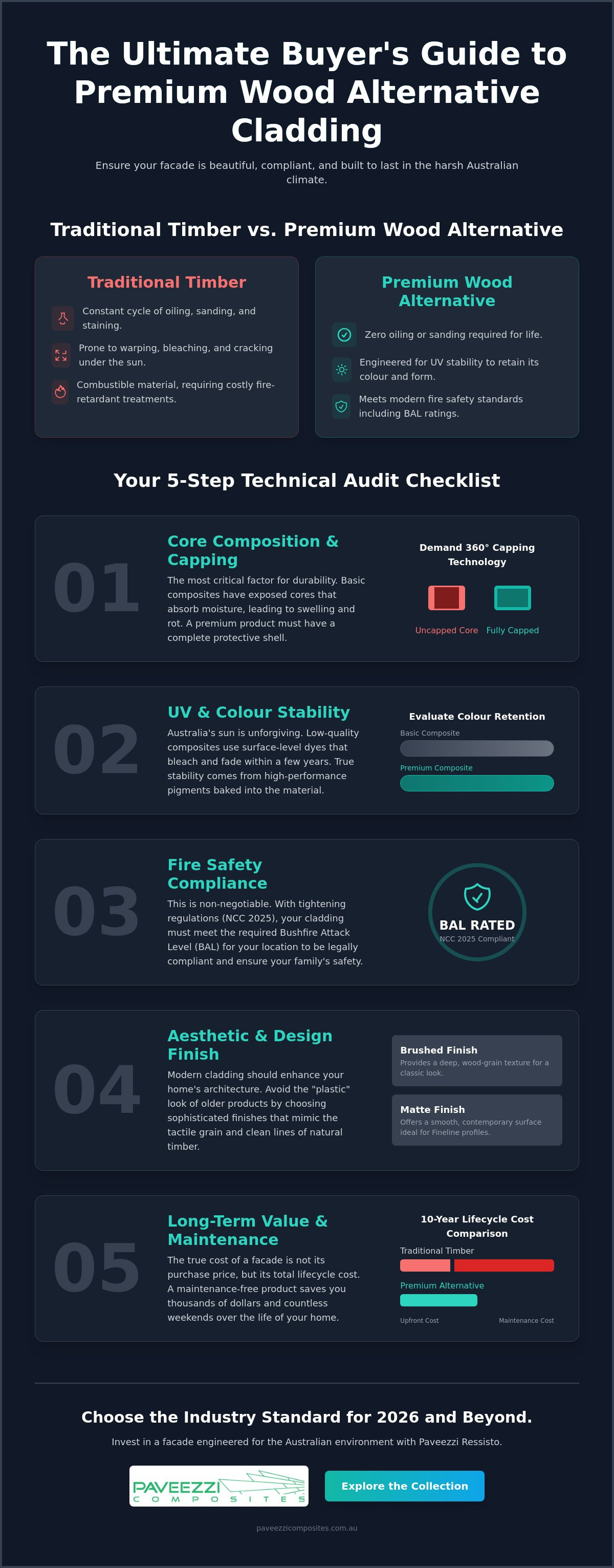
The Ultimate Buyer’s Checklist: 5 Steps to Selection
Selecting the right facade is a significant decision that impacts both the longevity and the street appeal of your project. While the visual allure of premium wood alternative cladding is undeniable, the selection process must be grounded in technical verification. We have formalised the selection criteria into a rigorous five-step audit. This ensures that your choice is not just a temporary decorative update, but a permanent architectural asset that thrives in our unique environment. This checklist provides a methodical path through the noise of the market to find true quality.
Step 1: Audit the material composition and capping thickness to ensure long-term core protection.
Step 2: Verify Australian compliance, specifically looking for BAL ratings (If needed)
Step 3: Evaluate the fixing system for ease of installation and its ability to manage thermal expansion.
Step 4: Request physical samples to test how the colour and texture respond to the local light on your specific site.
Step 5: Review the warranty terms, ensuring you understand the coverage for both residential and commercial applications.
Step 1 & 2: Technical Due Diligence
A high-performance board should ideally feature a co-extruded capping of at least 0.8 millimeter to ensure comprehensive protection against moisture and UV degradation. True technical due diligence involves looking past the marketing brochure. You need to verify that the product is designed specifically for the unique challenges of the Australian climate. This includes resistance to high salt spray in coastal regions and structural stability in the outback's heat. Always ask for third-party test results and certifications rather than relying solely on supplier claims. This is especially vital as we transition into the NCC 2025 requirements for weatherproofing and fire safety.
Step 3, 4 & 5: Practical and Aesthetic Verification
A concealed fixing system is a non-negotiable requirement for any premium facade. It provides a clean, fastener-free finish while allowing the boards to expand and contract without stress. The "Sample Test" is your most valuable aesthetic tool. Take your physical samples to the building site and view them at various times of the day. The way an extra-matte finish interacts with the low winter sun is vastly different from how it appears under a bright midday sky. Finally, ensure you distinguish between a basic product warranty and a performance guarantee. A 20-year warranty provides the peace of mind that your premium wood alternative cladding will remain vibrant and structurally sound for decades.
Ready to see the difference in person? We invite you to request a sample pack and experience the texture and quality of our architectural range for yourself.
Why Paveezzi Composites Ressisto collections are the Industry Standard for 2026
Paveezzi COMPOSITES occupies a unique position in the Australian construction landscape. As a family-run business with a national reach, we combine the personalized service of a boutique operation with the robust supply chain of an industry leader. We don't just sell products; we provide engineered solutions that have been rigorously tested for the specific demands of our climate. This commitment to excellence has positioned our range as the preferred premium wood alternative cladding for architects who refuse to compromise on either form or function. Our heritage as trusted pioneers means we have spent years refining our composites to ensure they meet the highest standards of durability and aesthetic precision.
Our approach is centered on solving the practical challenges faced by builders and developers. Whether you are working on a high-end residential build or a large-scale commercial development, the need for reliable, compliant materials is paramount. We support our partners with comprehensive technical specifications and a steady supply of stock, ensuring that project timelines are met without the stress of material shortages. By choosing Paveezzi Composites, you are partnering with a team that understands the nuances of the premium wood alternative cladding market and is deeply invested in the long-term success of your project.
The Ressisto Fineline 144 Advantage
The Cladding Ressisto Fineline 144 has emerged as the pinnacle of modern facade design for 2026. Its popularity stems from its unique shadow lines and perfectly balanced proportions, which create a sophisticated, linear rhythm across any surface. This profile is specifically engineered to surpass standard market alternatives through superior capping technology and a core material that resists the typical warping seen in lesser products. It is the definitive choice for contemporary Australian homes where a clean, architectural aesthetic is required. The Fineline profile doesn't just mimic timber; it improves upon it by providing a level of structural consistency that natural wood simply cannot match.
National Supply and Expert Guidance
For complex architectural projects that require lightweight yet durable solutions, our Lightissimo range, including the Cladding Lightissimo 400 and Lightissimo 195, offers incredible versatility. These systems are designed to reduce structural load while maintaining the premium look of a heavy-duty facade. We understand that every project has its own set of technical hurdles. That is why we offer expert guidance to help you navigate facade engineering and compliance requirements. Our national supply network ensures that whether your project is in a metropolitan center or a regional area, you have access to the same high standard of product and support. To move your project forward, we invite you to organize your samples and technical consult with our specialist team today.
Future-Proofing Your Next Architectural Project
Investing in a facade is a commitment to the longevity and safety of your home. By prioritizing technical compliance with the latest NCC 2025 standards and auditing material markers like capping thickness, you ensure your project remains a permanent asset. The shift toward high-performance systems means you no longer have to choose between the warmth of timber and the necessity of fire safety. As an Australian family-run business with national supply, Paveezzi Composites is dedicated to providing the specialized Ressisto and Lightissimo architectural ranges that modern builds demand.
Selecting premium wood alternative cladding is the final step in eliminating the burden of annual maintenance while achieving a sophisticated, linear aesthetic. We invite you to Explore the Ressisto Range and Request Your Samples Today to see how our engineered solutions can elevate your design. Our team is ready to support your vision with technical expertise and reliable supply for any project across Australia. We look forward to helping you build a legacy that stands the test of time.
Frequently Asked Questions
Is premium wood alternative cladding more expensive than natural timber?
Premium wood alternative cladding typically has a higher upfront purchase price than standard softwoods, but it is much more cost-effective over its total lifespan. You completely eliminate the recurring expenses of professional oiling, sanding, and staining that natural timber demands every year. When you calculate the rising cost of labor and specialized oils, the investment usually pays for itself within the first few years of ownership.
How long does composite cladding actually last in the Australian sun?
High-performance architectural composites are engineered to thrive for decades, often supported by a 20-year structural warranty. The advanced capping technology acts as a shield, protecting the core from the intense UV radiation that typically causes timber to warp and split. This ensures the facade retains its molecular integrity and color depth without the bleaching effects common in traditional wood products.
Can I install composite cladding in a high-risk bushfire zone (BAL-40 or FZ)?
Simple answer is NO, Most standard wood-plastic composites are rated for use up to BAL-29, but high-risk zones like BAL-40 or Flame Zone (FZ) usually require strictly non-combustible materials.
You must verify the specific fire engineering reports and AS 3959 compliance for your chosen profile before installation. For these sensitive projects, using non-combustible subframes and specifically tested non-combustible wall panels is the only way to ensure full legal compliance.
Does composite cladding require any maintenance at all?
This material is designed to be virtually maintenance-free, requiring no oiling, painting, or sanding throughout its life. A simple wash with soapy water and a soft brush once or twice a year is all it takes to remove environmental dust or coastal salt spray. It is the perfect solution for high-reach areas or multi-story builds where regular manual maintenance is difficult and expensive to organize.
What is the difference between Ressisto and Lightissimo profiles?
The Cladding Ressisto Fineline 144is defined by its deep architectural shadow lines, while the Lightissimo range focuses on lightweight engineering for specific structural needs. Profiles like the Cladding Lightissimo 400 or 195 allow architects to achieve a premium aesthetic on projects where reducing the overall load on the building frame is a priority. Both ranges utilize the same high-standard UV stability and moisture-resistant technology.
Is the color of the cladding consistent across different production batches?
Color consistency is significantly higher in manufactured composites than in natural timber because the pigments are precisely controlled during production. While we maintain tight tolerances, it is always best practice to order your total project requirements in a single batch to ensure a perfect match. This avoids the natural variations in grain and tone that can make traditional timber facades look patchy or inconsistent.
How does the expansion and contraction of composite cladding affect installation?
Composite materials naturally move with temperature fluctuations, a process that is managed through specialized hidden fixing systems and clips. These components allow the boards to expand and contract without putting stress on the fasteners or causing the panels to buckle. Professional installation must follow specific spacing guidelines to ensure the facade remains perfectly flat and stable during the peak of an Australian summer.
Can I use composite cladding for both residential and commercial buildings?
You can use these systems for both residential and commercial applications, provided the material meets the specific fire safety requirements for the building's classification. Commercial projects often mandate non-combustible materials for Type A and B constructions under the latest building codes. Our range includes options that satisfy these stringent standards, providing a durable and sophisticated finish for everything from private homes to large-scale retail developments.


Comments