
Vertical Composite Cladding: How to Achieve a Seamless Architectural Look
- info512916
- Jun 20
- 13 min read
What if the secret to a flawless, soaring facade isn't actually the boards themselves, but the invisible air moving behind them? It is a question that many Australian architects and homeowners grapple with as they seek that modern, elongated aesthetic. Achieving a high-end look with vertical composite cladding requires more than just picking a beautiful profile; it demands a deep understanding of how materials behave in our unique climate. You likely want the warmth of timber without the relentless cycle of oiling and sanding. However, the technical reality of vertical installation often brings valid concerns about moisture entrapment and thermal expansion.
We believe that building a home is a legacy, and you deserve a facade that remains as crisp as the day it was installed. This guide will help you master the technical requirements for a seamless finish. We will navigate the stringent condensation management rules of the NCC 2025, the use of vapor permeable membranes, and the importance of selecting AS 1530.1 and AS 1530.3 certified materials. We will also examine why a ventilated rainscreen system is non-negotiable for long-term structural integrity. You will learn how to manage batten orientation and expansion gaps using precision-engineered solutions like the Ressisto Fineline 144. By the end, you will have the clarity needed to deliver a sophisticated, zero-maintenance exterior that truly performs. It is about precision and peace of mind.
Key Takeaways
Discover how vertical lines create a sense of architectural grandeur and why this orientation is a contemporary staple for modern Australian homes.
Understand the critical technical shifts required for NCC 2025 compliance, focusing on vapour permeable membranes and effective condensation management.
Compare premium profiles for vertical composite cladding, from the deep shadowlines of the Ressisto Fineline 144 to the refined, flat-joint finish of the Lightissimo 202 & 195.
Learn how to solve the "gravity challenge" of moisture drainage by preparing a ventilated rainscreen system that protects your structural integrity.
Master the installation sequence, from setting a perfect anchor board to managing thermal expansion for a seamless, low-maintenance result.
Table of Contents
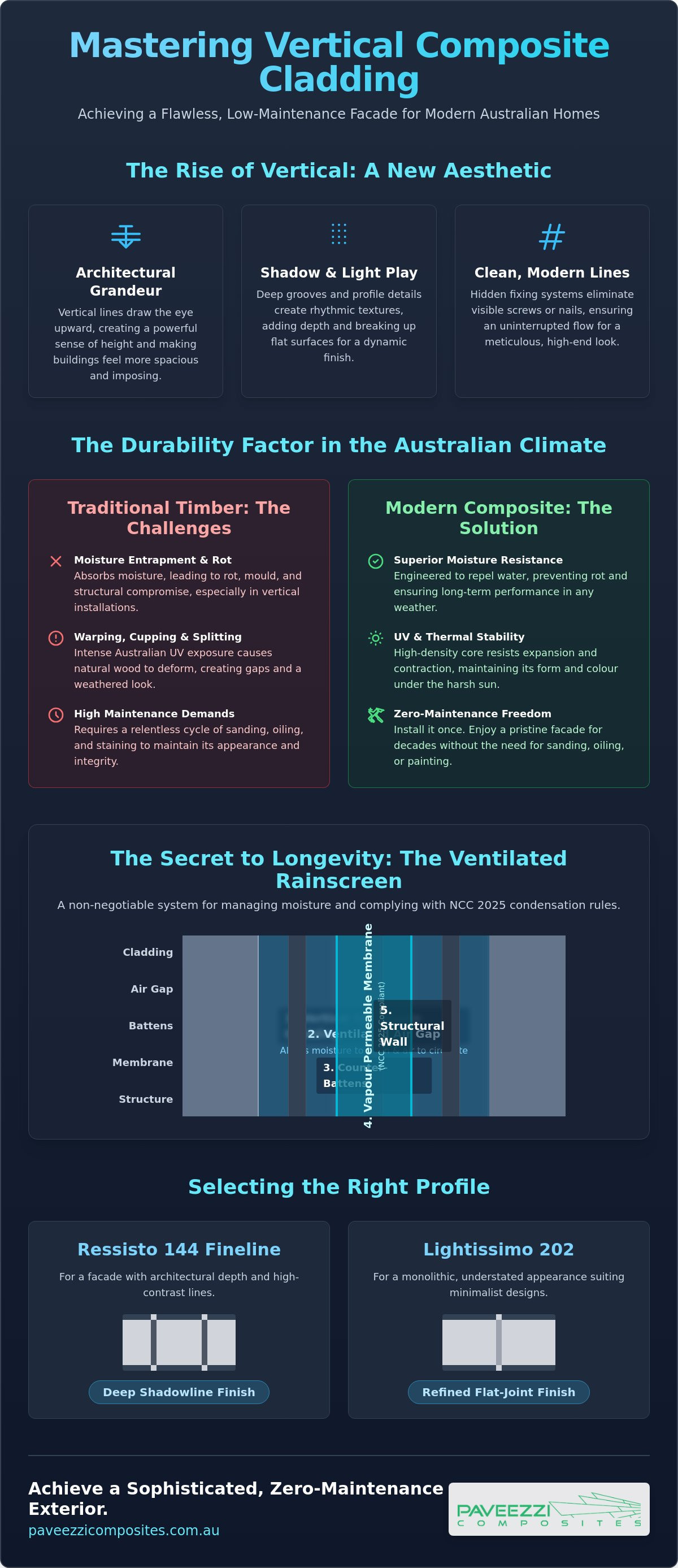
The Rise of Vertical Composite Cladding in Australian Architecture
The Australian architectural landscape is undergoing a sophisticated shift. For decades, the classic "weatherboard" look defined our suburbs, characterized by horizontal lines that hugged the earth. However, modern design is looking upward. Vertical composite cladding has emerged as a premier alternative to traditional timber, offering a sleek, contemporary aesthetic that challenges the status quo. This isn't just about changing the direction of a board; it's a fundamental reimagining of how a building interacts with its environment. By moving away from the "cottage" styles of the past, homeowners and developers are embracing modern-industrial and contemporary-coastal aesthetics that feel both grounded and aspirational.
The evolution of Cladding has always been driven by a need for better protection and better style. While timber was once the only choice, the demands of the Australian climate have made high-performance composites the logical successor. These materials provide the warmth and organic texture of wood but are engineered to withstand the intense pressures of our sun-drenched coastlines and arid inland regions. It is a transition from high-maintenance tradition to high-performance modernity.
Visual Benefits: Height, Texture, and Modernity
Vertical lines have a powerful psychological impact on the viewer. By drawing the eye from the ground to the sky, vertical boards create an immediate sense of height and architectural grandeur. This is particularly effective for single-storey structures, where the orientation can make a modest home feel significantly more imposing and spacious. It's a clever design trick that adds value without changing the building's footprint.
Beyond height, the vertical orientation allows for a more creative use of shadow and light. Depending on the profile chosen, the deep grooves between boards create rhythmic textures that break up large, flat wall surfaces. This creates a "seamless" look that is further enhanced by hidden fixing systems. These systems ensure that no screws or nails disrupt the clean, vertical flow, allowing the material's natural beauty to take centre stage. The result is a facade that looks meticulously crafted rather than simply assembled.
The Durability Factor in the Australian Climate
In Australia, the afternoon sun is a relentless force. Traditional timber boards, when installed vertically, are particularly susceptible to the "gravity challenge." Moisture can sit in horizontal joins, while the intense UV exposure causes natural wood to warp, cup, and split over time. This leads to visible gaps and a compromised building envelope. High-quality composites solve these issues through superior engineering. They don't absorb moisture like timber does, and their high-density cores provide the structural stability needed for long-term vertical performance.
Choosing a composite solution also means choosing a maintenance-free future. There is no need for the exhausting cycle of sanding, oiling, or staining every twelve months. These boards are designed to retain their color and integrity for decades, even on north-facing walls that bear the brunt of the heat. It's a reassuring prospect for any property owner who values their time as much as their home's appearance. You get the enduring beauty of a timber facade without the hidden costs of constant upkeep.
Selecting the Right Profile: Fineline vs. Lightissimo
Choosing the right profile is where your architectural vision begins to take physical form. While many suppliers offer a standard shiplap board, we have developed our ranges to provide distinct visual languages. The choice between a "shadow line" effect and a "ribbed " finish will define the character of your project. A ribbed profile uses deep grooves to create high-contrast vertical bands. This adds a layer of complexity and depth to the facade. Conversely, a flat-joint finish provides a more monolithic, understated appearance that suits minimalist designs where the material's texture is the hero. It is a decision that requires both an eye for detail and an understanding of the Building Code of Australia (BCA) standards for external wall performance.
The rhythm of your facade is also dictated by board width. A narrower 144mm board creates a tighter, more energetic visual frequency. This is often used to accentuate height on smaller feature walls. Larger boards, such as the 202mm or 400mm options, offer a calmer, more expansive feel that is perfect for large surfaces
How these boards catch the light is equally important. A brushed finish diffuses the harsh Australian sun, giving the wall an organic, tactile quality. A matte finish provides a clean and modern look that remains consistent throughout the day. If you are looking for the perfect balance of style and performance, you can explore our architectural samples to see these finishes in person.
Ressisto Fineline 144: The Modern Architect’s Choice
The Cladding Ressisto Fineline 144 is our most sought-after profile for high-end residential projects. Its signature "Fineline" groove creates a sophisticated, repetitive texture that mimics the precision of architectural timber battens. It is the ideal choice for entrance facades or feature walls where you want to make a bold statement. The hidden fixing system ensures that the vertical lines remain uninterrupted, providing a truly seamless finish that stands up to the closest inspection.
Ressisto Lightissimo: Lightweight Performance
For larger-scale applications, the Cladding Ressisto Lightissimo 195 & 202 and Cladding Lightissimo 400 ranges offer a significant engineering advantage. These panels are specifically designed to be lightweight without compromising on the high-density composite core's integrity. This makes vertical composite cladding much easier to handle on the garage doors or when working at height, such as on high-reach gable ends or expansive soffits. By reducing the physical load on the installation team, Lightissimo simplifies the process while delivering a premium, large-format aesthetic that is difficult to achieve with heavier traditional materials.
Technical Considerations: Vertical vs. Horizontal Installation
It's a common mistake in the building industry to assume that vertical composite cladding is merely a horizontal system turned on its side. Physics doesn't work that way. When you rotate a cladding board 90 degrees, you fundamentally change how the building envelope interacts with gravity and water. In a horizontal orientation, the boards naturally shed water over the face of the profile. In a vertical setup, the grooves and joins are aligned with the path of falling rain. This creates a unique "gravity challenge" where moisture can be driven into the joints or sit in horizontal recesses if the profile isn't specifically designed for vertical use. Without a dedicated strategy for drainage, you risk moisture entrapment against the building's frame.
Successful installation requires a shift from thinking about "cladding" as a single layer to viewing it as a managed system. A Comprehensive Review of Aluminum Composite Panels and high-density composites highlights how material stability and installation methods are critical for long-term performance in varied climates. In Australia, this means moving toward a ventilated cavity. This approach ensures that your facade isn't just a decorative skin, but a functional barrier that protects the structural integrity of the home. The role of starter trims and flashing becomes paramount here; they aren't just finishing touches, but essential components that direct water away from the substrate.
Moisture Management and Drainage
If a system is not designed for vertical use, water can sit in horizontal grooves or at the junction of the boards and the base trim. This leads to the "gravity challenge" where standing water eventually finds a way into the structure. To combat this, your installation must include a "weep hole" logic at the base of all vertical cladding runs. These small openings allow any water that enters the system to escape freely. A ventilated rainscreen is a system where air circulates behind the cladding to equalise pressure. This airflow is the most effective way to prevent mould and structural rot by allowing any moisture that penetrates the facade to evaporate quickly. It's a proactive approach to building health that is now increasingly reflected in Australian building standards.
Battening Requirements for Vertical Boards
The battening for vertical boards is more complex than horizontal applications. You cannot simply fix horizontal battens directly to the wall studs. Doing so creates "dams" that trap water and debris against the house wrap, leading to rapid decay. Instead, we recommend a cross-battening method. This involves installing vertical primary battens first to create a clear drainage and ventilation path. Horizontal secondary battens are then fixed over the top to provide the necessary support for the cladding boards. This double-layer approach ensures the weight is distributed evenly to prevent "snaking" or bowing over time. Proper spacing is vital; battens should typically be placed at 400mm or 500mm centers to support the vertical load and maintain the crisp, straight lines of your architectural design.
How-to Guide: Achieving a Seamless Vertical Installation
Achieving a truly seamless architectural finish requires a shift in mindset from simple construction to precision engineering. Every line must be perfectly plumb, and every join must account for the physical realities of the Australian environment. The process begins with the substrate. You must ensure the wall is wrapped in a high-quality breathable sarking, which acts as the secondary line of defence against moisture while allowing the building to breathe. Once the primary vertical battens are secured, the foundation for your vertical composite cladding is set. It is about creating a system that manages air and water as effectively as it manages aesthetics.
The success of the entire wall depends on the first board. This "anchor" board must be set with absolute precision using a laser level. If the first board is even a millimetre out of alignment, the error will compound across the facade, leading to visible "snaking" or uneven gaps at the corners. We recommend using hidden clips and screws to maintain the clean, uninterrupted lines that define modern architecture. This approach ensures that no fixings are visible on the face of the boards, preserving the integrity of the shadowline or flat-joint profile you have selected.
Step-by-Step: From Sarking to Finishing Trims
Step 1: Install vapor permeable sarking as per NCC 2025 requirements, followed by primary vertical battens to establish the drainage cavity.
Step 2: Fix horizontal counter-battens over the vertical ones. Leave a small gap between the ends of horizontal battens to ensure air can still circulate vertically behind the boards.
Step 3: Install the starter trim at the base of the wall. Use a laser level to ensure it is perfectly level across the entire run.
Step 4: Progressively install your boards from one corner. Check for vertical alignment with a spirit level every three boards to catch any minor deviations early.
To ensure your project meets these high standards, you can view our full installation technical data sheets for detailed cross-sections and fixings specifications.
Managing Expansion and Contraction
The Australian sun is a significant factor in facade design. Composite boards, like all building materials, will expand and contract as they reach high temperatures during a summer afternoon. For a vertical run, this movement occurs primarily along the length of the board. You must provide specific gap requirements at the head and base of the wall, typically hidden by flashing or trim. If you are fixing through the center of the board to prevent "slumping," ensure the rest of the fixings allow for movement at the ends. This prevents the boards from buckling or warping when the temperature peaks.
Corner Details and Junctions
The treatment of corners and window reveals is what separates a DIY effort from a professional architectural finish. For a clean, modern look, you can choose between a mitered corner or an L-trim finish. While mitering provides a sharp, continuous timber look, it requires expert carpentry. Many professionals prefer our system accessories. Options, which provide a robust and tidy edge that handles thermal movement more forgivingly. When integrating cladding with windows and doors, always ensure that flashing is installed to direct water over the face of the cladding rather than behind it.
This prevents water traps that could lead to long-term structural issues.
Why Paveezzi COMPOSITES is the Premier Choice for Australian Facades
Choosing the right material for a vertical facade is a decision that impacts the longevity and value of your project for decades. Paveezzi’s Composites high-density composite core is engineered specifically for the structural demands of vertical orientation. Unlike less dense alternatives that may struggle with their own weight, our boards maintain exceptional rigidity and dimensional stability. This engineering prevents the slumping or bowing that can plague vertical installations over time. As a family-run operation, we bring a personal commitment to every project, combining industry-leading innovation with the heart of a dedicated partner. We understand that an Australian facade must be as resilient as it is beautiful.
The aesthetic success of vertical composite cladding also depends on how it interacts with the harsh Australian light. Large vertical surfaces can often create uncomfortable glare if the finish is too reflective. Our brushed and extra matte finishes are specifically designed to diffuse sunlight, providing a soft, natural appearance that enhances the architectural rhythm of the boards. This attention to detail extends to our accessories. These components ensure that every corner, reveal, and junction is finished with the same level of quality as the main field of cladding, resulting in a cohesive and truly holistic architectural result.
The Paveezzi COMPOSITES Advantage: Quality and Performance
Our products undergo rigorous testing to ensure they exceed the requirements of the Australian climate. We take a no-nonsense approach to supply, providing honest technical support and clear documentation to help you navigate complex building codes. We believe in empowering our partners with knowledge. For those looking to deepen their understanding of modern facade trends and technical compliance, we encourage you to Australian Design Guide for more inspiration and technical insights. It is about providing the security of a proven system alongside the beauty of modern design.
Next Steps for Your Project
Planning your vertical facade requires careful calculation to ensure a seamless finish without excessive waste. When working with our Cladding Ressisto Fineline 144, remember that the 144mm width defines the visual rhythm of your wall. Calculate your total surface area and allow for a 5 to 10 per cent wastage factor, depending on the complexity of your window reveals and corners. While our systems are designed for straightforward installation, we always suggest consulting with a professional builder for complex vertical layouts. Their expertise ensures that the ventilated rainscreen and battening systems discussed in previous sections are executed to perfection.
If you are ready to transform your project with a high-end, low-maintenance facade, our team is here to help. You can enquire about Ressisto Fineline 144 for your next project to receive personalized advice and a detailed quote. We look forward to helping you achieve a soaring, seamless architectural look that stands the test of time.
Transforming Your Project with Lasting Architectural Impact
Mastering the technical nuances of a ventilated rainscreen and selecting a profile that speaks to your design's rhythm is the key to a successful build. You have seen how vertical composite cladding is more than just a stylistic choice; it is a sophisticated system designed to protect and elevate the Australian building envelope. By prioritizing proper moisture management and precision alignment, you ensure your facade remains a point of pride for years to come. It is about combining an ambitious vision with the structural integrity required to withstand our unique environment.
Since 2010, our family-run Australian business has been dedicated to providing the industry with specialized solutions like the Ressisto collections and Lightissimo architectural ranges. These products aren't just aesthetically pleasing; they're engineered to thrive under the intense Australian UV and climate. We take pride in being a stable, knowledgeable ally for architects and homeowners alike. It is time to move beyond the relentless upkeep of timber and embrace the future of high-performance facades. Explore our PAVEEZZI COMPOSITES full range and discover the difference that precision engineering makes. We are ready to help you create something extraordinary.
Frequently Asked Questions
Can I install vertical composite cladding directly onto a brick wall?
No, you shouldn't install cladding directly onto a masonry or brick surface. To maintain the integrity of your vertical composite cladding, you must first install a batten system to create a ventilated cavity. This air gap is essential for moisture management and prevents thermal bridging, ensuring that your structural wall remains dry and well-protected from the elements.
Do I need special tools to cut vertical composite cladding boards?
No specialized machinery is required; standard woodworking tools are perfectly suitable. We recommend using a miter saw or circular saw fitted with a high-quality, carbide-tipped blade to achieve the cleanest possible finish. Because our Ressisto and Lightissimo ranges are high-density, a sharp blade ensures precision cuts without fraying or melting the composite material.
How do I handle the gap at the bottom of the cladding to prevent pests?
You should install a perforated starter trim or a dedicated vermin mesh at the base of the wall. This allows for the critical airflow required by a ventilated rainscreen system while creating a physical barrier against rodents and large insects. It's a simple addition that protects the structural cavity without compromising the drainage performance of your facade.
Is vertical cladding more expensive to install than horizontal?
The material costs are identical, but the installation labor is often slightly higher due to the battening requirements. Vertical boards require a cross-battening system, involving vertical primary battens followed by horizontal secondary battens, to ensure proper drainage and airflow. While this adds a step to the preparation, it is a necessary investment to ensure the long-term stability of your architectural finish.
What is the best way to clean vertical composite cladding?
A simple wash with warm soapy water and a soft-bristled brush is all that is required. Because our boards are engineered for low maintenance, you don't need harsh chemicals or pressure washers, which can actually damage the surface texture. Regular rinsing with a garden hose will remove dust and salt spray, keeping the "extra matte" or "brushed" finish looking pristine.
Does vertical cladding require a specific BAL rating for bushfire areas?
Yes, external cladding must comply with the Bushfire Attack Level (BAL) requirements specified in AS 3959 for your specific site. Under the NCC 2025, it's vital to verify that your chosen material meets the necessary fire safety standards, such as AS 1530.1 or 1530.3 certification. Always consult your building certifier to ensure your project aligns with local bushfire safety regulations.
Can I mix vertical and horizontal cladding on the same house?
Mixing orientations is an excellent way to define different architectural volumes and add visual interest to a home. You can use vertical boards to accentuate a grand entrance or a high gable while using horizontal boards for the main body of the house. Our matching trim systems ensure that the transition between different orientations remains clean and professionally finished.
How do I ensure the vertical lines stay perfectly straight over time?
The secret to straight lines is a combination of a perfectly level starter trim and correct batten spacing. You must use a laser level for the initial setup and check the plumb of your boards every three or four rows. Additionally, ensuring your battens are spaced at 400mm or 500mm centers provides the necessary support to prevent the boards from bowing as they expand and contract.


Comments