
Salt Water Resistant Decking Material: The Australian Guide (2026)
With over 80% of Australia's population living within 100 kilometres of the coastline, choosing an authentic salt water resistant decking material isn't just an aesthetic preference; it's an engineering necessity. If you've spent sweltering weekends sanding down sharp splinters around a chlorinated pool, scrubbing away white salt crusts, or watching boards cup under relentless coastal heat, you know the frustration. Natural timber simply wasn't built to withstand the punishing physical expansion of salt crystals trapped beneath the surface.
You shouldn't have to spend your free time stripped down with an oiling rag just to keep your entertaining area safe. In this guide, you'll discover how fully capped composite technology creates an impervious barrier against saltwater absorption, eliminating annual sealing while keeping outdoor spaces splinter-free and barefoot-friendly. We explore the essential slip standards under AS 4586, optimal subfloor drainage methods, and the exact hardware specifications required to build a coastal deck that lasts for decades.
Table of Contents
The Coastal Challenge: How Salt Water Degrades Traditional Decking
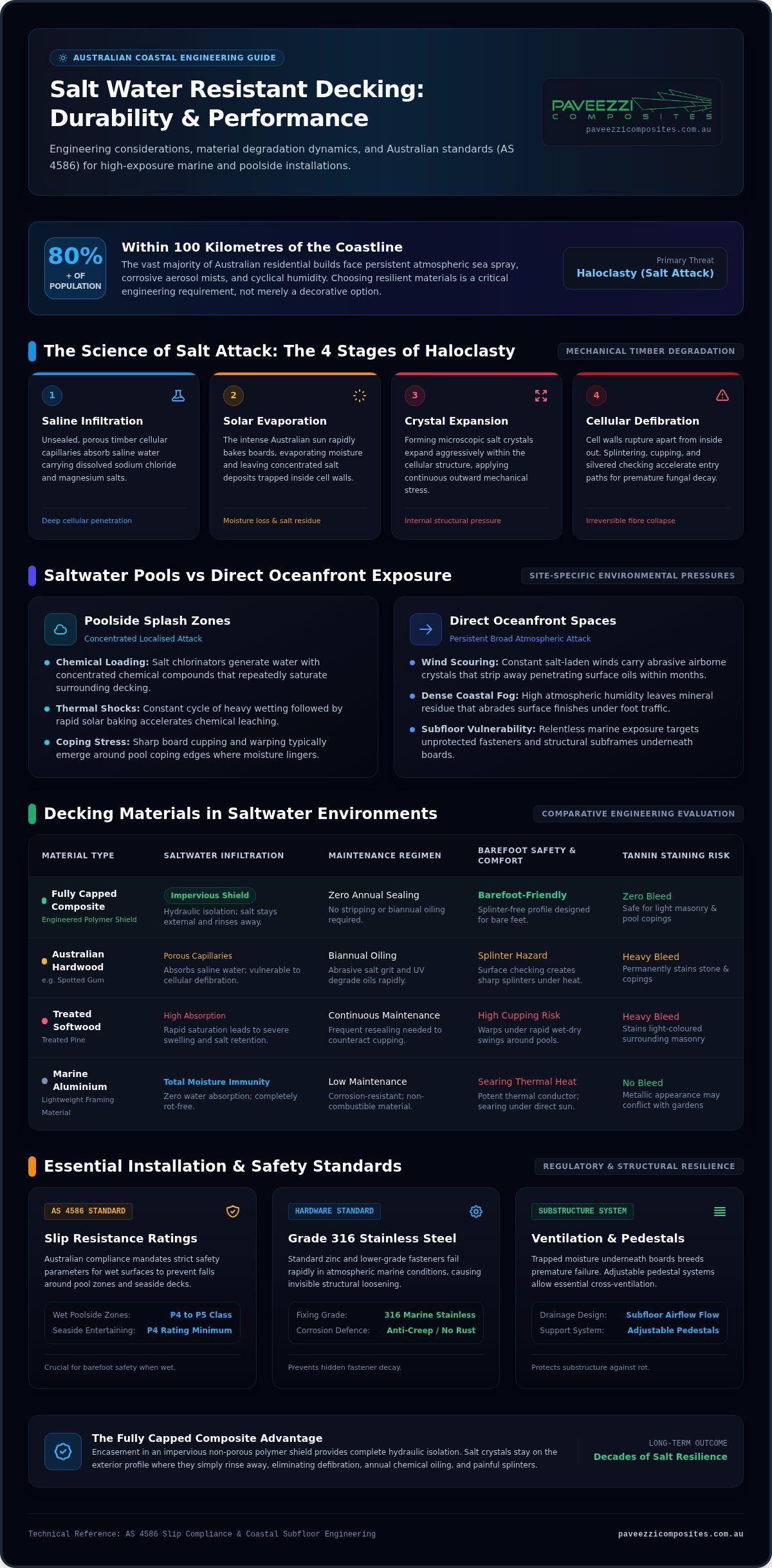
Airborne sea spray and microscopic salt mists subject seaside structures to persistent chemical and physical wear. While many builders attribute coastal deck failure simply to high moisture levels, the primary culprit behind board deterioration is a mechanical process known as haloclasty, or salt crystallisation. Without an authentic salt water resistant decking material, outdoor timbers quickly surrender to this cycle of saturation, evaporation, and cellular collapse.
When unsealed timber absorbs saline water, dissolved sodium chloride and magnesium salts penetrate deep into the cellular capillaries. As the warm Australian sun dries the surface, moisture evaporates, leaving concentrated salt behind. These microscopic crystals expand rapidly within the cell walls, physically prying natural fibres apart in a destructive process called defibration. Combined with tropical and coastal humidity, this structural fracturing creates porous pathways where fungal decay takes hold, causing rapid board failure long before expected lifespans.
A true salt water resistant decking material must provide complete hydraulic isolation, preventing saline moisture from penetrating its internal core while retaining structural dimensional stability against heavy atmospheric salt loads.
The Chemistry of Salt Attack on Timber
Timber behaves like a dense sponge. Each time ocean swells spray aerosol mists or swimmers track water across the boards, porous grain absorbs mineral-heavy moisture. The resulting internal salt growth fractures the wood from the inside out, creating the fuzzy, silvered texture often mistaken for simple weathering.
Surface coatings rarely survive this environment. Ultraviolet radiation degrades surface sealers, while crystalline salt deposits turn into abrasive grit under daily foot traffic. This friction strips penetrating oils within months, leaving raw timber exposed. For lasting resilience, engineered alternatives such as advanced wood-plastic composite decking encase structural cores within non-porous polymer shields, keeping salt deposits strictly on the exterior where they simply rinse away.
Saltwater Pools vs Oceanfront Exposure
While oceanfront decks face broad atmospheric attack, poolside platforms confront intense localised exposure. Salt chlorinator systems introduce water with concentrated chemical compounds that repeatedly soak surrounding timber. Understanding these distinct environments helps clarify material performance:
Poolside splash zones: Experience continuous cycles of wetting and fast solar baking. This concentrated exposure speeds up chemical leaching and produces sudden board cupping around coping edges.
Direct oceanfront spaces: Suffer constant scouring from salt-laden winds and dense coastal fog. This relentless exposure breaks down unprotected fasteners and subfloor frameworks.
Safety remains paramount. Salt-damaged timber cracks and splinters, creating genuine hazards for wet, bare feet. Modern installations require surface profiles that stay splinter-free, slip-resistant, and comfortable to walk on during scorching summer afternoons.
Comparing Decking Materials for Saltwater Environments
Selecting the right salt water resistant decking material involves balancing moisture absorption, barefoot safety, and ongoing upkeep. While traditional builds historically relied on native timber, modern coastal architecture increasingly favours engineered surfaces designed to withstand constant salt exposure without continuous structural maintenance.
Hardwood and Treated Softwood Limitations
Dense Australian hardwoods like Spotted Gum offer substantial natural strength, yet they remain porous. Salt deposits degrade surface sealers rapidly, requiring biannual oiling to prevent surface checking. Treated pine proves even more temperamental, warping and cupping under rapid wet-dry swings. Both timbers also release heavy tannin bleed when saturated, permanently staining expensive pool copings and light-coloured surrounding masonry.
Aluminium Decking: Durable but Thermally Intense
Marine-grade aluminium provides total moisture immunity, preventing water absorption entirely. It will not rot, resisting coastal corrosion while aligning well with Australian Government guidance on lightweight framing regarding non-combustible materials. However, metal acts as a potent thermal conductor. Under direct summer sun, unshaded aluminium boards become searingly hot for bare feet, while their rigid metallic aesthetic often conflicts with natural residential landscape design.
Capped Composite Decking: The Balanced Solution
First-generation uncapped composite boards struggled near the coast because exposed wood flour absorbed water, trapping salt inside the core. In contrast, modern fully capped boards feature an impervious 360-degree polymer shell. This protective barrier prevents saline penetration entirely, keeping salt deposits on the surface where they quickly wash away without lifting grain or harbouring mould.
By combining natural wood aesthetics with splinter-free comfort and zero tannin runoff, capped boards stand out as the ideal salt water resistant decking material for poolside spaces. Homeowners looking to eliminate annual sanding and sealing can explore a durable composite decking range engineered for tough Australian conditions.
Key Selection Criteria for Coastal and Poolside Decking
Specifying boards for an oceanfront alfresco or pool surround requires evaluating strict performance benchmarks. Beyond basic water resistance, selecting a durable salt water resistant decking material demands close attention to wet surface friction, solar stability, and corrosion-proof hardware integration.
Slip Resistance and Surface Texture
Under Australian Standard AS 4586, pedestrian surfaces subject to regular wetting, such as swimming pool surrounds, require a minimum slip resistance classification of P4 or R11. High-risk zones often benefit from P5 ratings. Achieving this safety threshold does not require coarse, uncomfortable surfaces. Lightly brushed textures and extra matte finishes provide dependable mechanical grip beneath wet feet while remaining pleasant to walk across barefoot.
UV Stability and Thermal Performance
Marine environments endure magnified solar radiation. Sunlight reflects directly off water and pale sands, doubling the ultraviolet exposure hitting horizontal surfaces. Lesser formulations experience rapid pigment chalking and patchy fading when exposed to this concentrated radiation alongside salt deposits. Advanced boards incorporate stabilised colour pigments and low-sheen surfaces that diffuse blinding afternoon glare, maintaining visual elegance and balanced foot temperatures throughout hot summer days.
Fastener Selection and Edge Protection
Even the toughest deck board will fail if secured with inadequate hardware. Standard galvanised fixings quickly succumb to airborne chlorides, resulting in rust runs and compromised structural integrity. In coastal environments, following ASSDA coastal corrosion recommendations is essential: specify Grade 316 marine-grade stainless steel screws and hidden clips to prevent pitting and tea-staining.
To ensure total system longevity, complete your installation with tailored edge profiles and nosing solutions:
Concealed edge nosing: Wraps outer deck borders and stair treads, shielding exposed edges from physical impacts.
Hidden clip systems: Prevent surface penetrations where standing saltwater can pool around screw heads.
By pairing proven hardware with high-performance salt water resistant decking material, you eliminate the safety hazards common to ageing timber. To plan your next coastal entertaining build, explore Paveezzi Composites high-performance composite decking systems engineered specifically for severe seaside conditions.
Substructure and Airflow: Building a Long-Lasting Saltwater Deck
Even the highest-grade salt water resistant decking material will underperform if the substructure beneath it traps moisture. In coastal zones, forensic timber engineering reports reveal that 60% of premature deck structural failures stem directly from inadequate substructure airflow and clearance. When dense salt mists settle beneath boards with insufficient ventilation, relative humidity remains perpetually near saturation, accelerating hardware oxidation and subframe decay.
Ventilation and Ground Clearance Requirements
Airflow acts as a natural drying mechanism against aerosol sea spray. Ground clearance must meet National Construction Code benchmarks, maintaining at least 6,000 square millimetres of continuous cross-ventilation per lineal metre of perimeter. Avoid boxing in deck perimeters with solid fascia boards down to ground level; doing so creates an unvented saline terrarium. Underlying slabs must also incorporate a slight fall, directing pooling splashback away from structural foundations toward active stormwater drains.
Using Adjustable Pedestals for Superior Drainage
Low-clearance installations over existing concrete pool surrounds present unique drainage hazards. Bolting framing directly onto coastal concrete traps standing saltwater underneath joists. Utilising engineered pedestals elevates the subframe entirely, creating a continuous, unobstructed drainage cavity where wash water flows freely beneath the deck.
Systems like the RHINO adjustable pedestal range and self-levelling pedestals simplify levelling across irregular outdoor slabs. By isolating framing members from damp masonry, pedestals prevent premature structural deterioration while preserving critical airflow.
Long-Term Care and Maintenance Routine
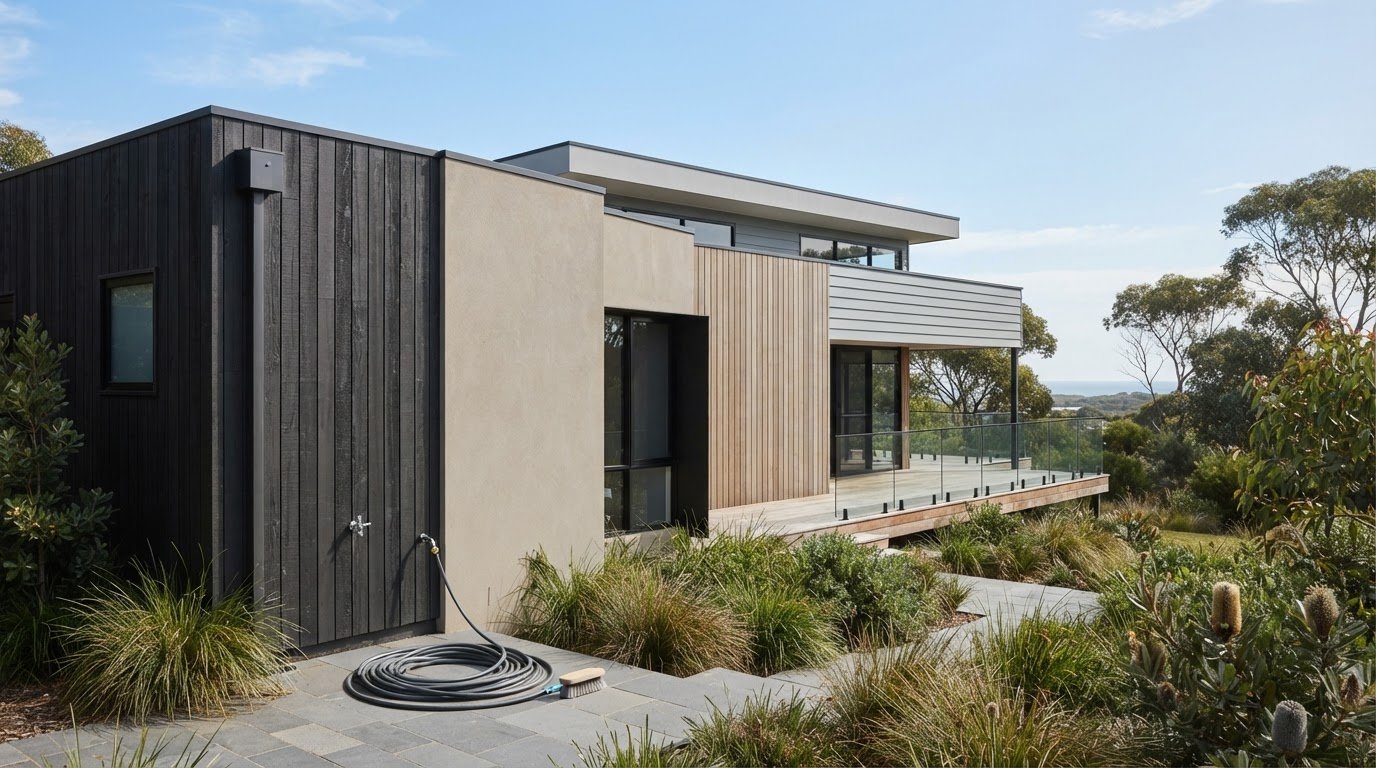
Maintaining a fully capped composite deck in a marine setting requires minimal manual labour. Unlike timber, which demands seasonal chemical stripping, capped surfaces only need a routine rinse with fresh domestic tapwater every few weeks to disperse surface salt crusts. Avoid harsh acid washes or pressure washers held too close to the surface, as clean water and a soft-bristled broom are all it takes to keep boards looking immaculate.
Designing a dependable seaside entertaining area begins with an engineered, complete system approach. To select the ideal profile and sub-deck accessories for your project, explore the Paveezzi composite collection to create an outdoor space built for the Australian elements.
Build a Resilient Coastal Retreat Designed to Last
Creating an enduring seaside deck comes down to engineering foresight. When you stop the cycle of salt crystal absorption at the surface and facilitate active subfloor drainage underneath, outdoor entertaining areas thrive against harsh marine conditions. Specifying a proven salt water resistant decking material safeguards your home against splintering, cupping, and endless seasonal oiling rituals.
As a family-run Australian business providing specialised material engineering since 2010, Paveezzi supplies high-performance capped composites built specifically for local coastal weather. Collections like Decking Ressisto 143 Brushed and Decking Ressisto 138 Extra Matte combine refined textures with ultra-low moisture absorption, keeping barefoot spaces safe, comfortable, and visually captivating year after year.
Protect your investment with materials engineered to outlast the surf and sun. Explore Paveezzi coastal decking solutions to specify the ideal boards and RHINO pedestal systems for your next poolside or oceanfront build.
Frequently Asked Questions
Can salt water damage composite decking boards over time?
High-quality, fully capped composite boards will not suffer structural damage from salt water. Unlike timber, which absorbs saline moisture and fractures as internal salt crystals expand, fully capped boards feature an impermeable polymer shield. This barrier prevents salt and moisture from reaching the composite core. As long as you select an authentic salt water resistant decking material, the boards will not cup, rot, or splinter when exposed to marine mist.
How do you clean salt residue and dried sea spray off composite decks?
Cleaning dried salt deposits requires little more than fresh tapwater and a soft-bristled broom. Simply hose down the surface every few weeks to dissolve crystalline build-up before it turns into an abrasive haze. For stubborn grime or sunscreen marks around pool zones, mix a mild household dishwashing detergent with warm water, scrub gently along the grain, and rinse thoroughly. Never use harsh bleach, acid washes, or metal wire brushes.
What screw and clip grade should be used for decks near salt water?
Always specify Grade 316 marine-grade stainless steel screws, hidden clips, and framing fasteners in coastal and poolside settings. Grade 316 contains added molybdenum, which provides essential resistance against pitting corrosion and tea-staining caused by airborne chlorides. Lower-grade options like Grade 304 or standard galvanised fixings deteriorate rapidly within atmospheric marine zones, staining the boards and dangerously weakening the underlying structural frame over time.
Is composite decking suitable for saltwater pool surrounds across Australia?
Yes, fully capped composite decking is engineered specifically to withstand saltwater pool surrounds across the country. It remains completely immune to chemical leaching, chlorine degradation, and the constant wet-dry cycles typical of pool splash zones. Premium ranges, such as Paveezzi's Decking Ressisto collection, eliminate the risk of barefoot splinters while maintaining dimensional stability under intense sunlight, making them an ideal salt water resistant decking material for poolside family living.
Does salt water make composite decking surfaces slippery when wet?
Salt water can leave slick mineral deposits if allowed to dry repeatedly without rinsing, but quality composite boards prevent slipperiness through engineered surface textures. Selecting boards with a brushed or extra matte finish ensures reliable underfoot traction even when drenched. Under Australian Standard AS 4586, boards achieving a P4 or P5 wet pendulum slip resistance rating provide safe, barefoot-friendly stability around wet swimming pool perimeters and exposed seaside verandas.
Why is capped composite superior to uncapped composite in coastal climates?
First-generation uncapped composite boards contain exposed wood fibres that absorb airborne salt spray and moisture, leading to internal salt crystallisation, core swelling, and mould growth. Capped composites encase the composite core in an impenetrable 360-degree outer polymer shield. This protective layer seals out moisture entirely, protects pigments from intense solar ultraviolet degradation, and ensures salt deposits remain strictly on the surface where they easily wash away.

Comments